DATELINE: MAY 2026 – As regional conflicts in the Middle East continue to destabilize global LNG and oil markets, a secondary crisis is entering the homes of millions: the hyper-inflation of cooling costs. With electricity rates hitting record highs in both Western and Asian markets, the air conditioning industry is reaching a “Efficiency Flashpoint” where traditional HVAC maintenance is no longer enough to offset the surge in utility bills.
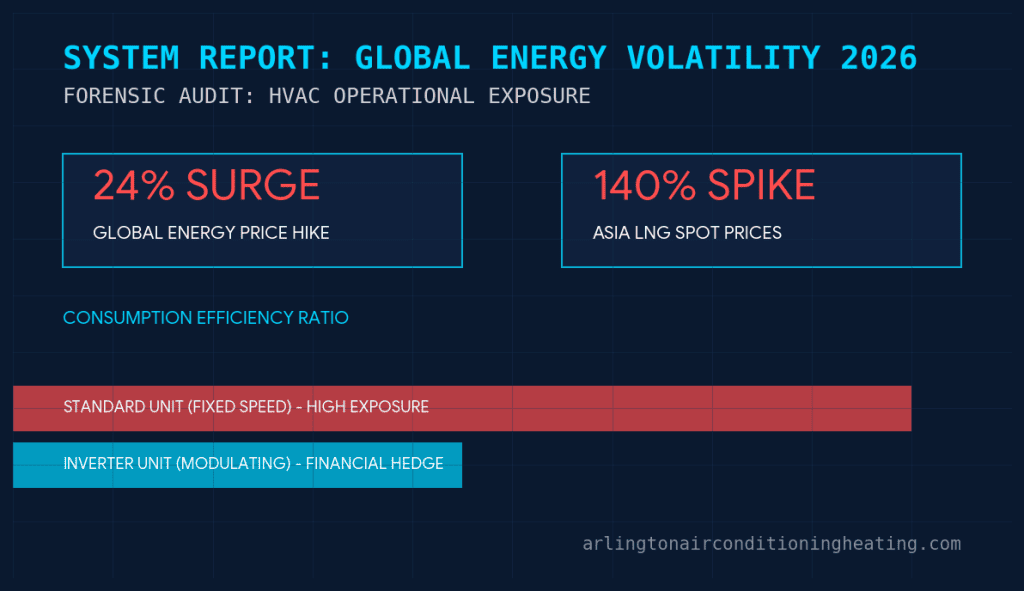
The geopolitical landscape changed on March 4, 2026. The closure of the Strait of Hormuz is now officially recognized as the largest supply disruption in the history of the global oil market, sending shockwaves through every local utility provider.
The Macro-Economic Hook: Why Your AC is a Geopolitical Asset
This isn’t a temporary spike. Retail electricity rates rose 7.1% in 2025 and are continuing to accelerate throughout 2026, leaving standard cooling systems economically obsolete.
[SYSTEM AUDIT: COOLING INFLATION]
CALIBRATED FOR MAY 2026 ENERGY TARIFFS
Ready to neutralize your energy risk?
> Book a Forensic Efficiency Audit.
Air conditioning accounts for roughly 20% of total electricity used in buildings globally. As energy grids face the double-pressure of supply chain disruptions and increased fuel costs, the “Cost per BTU” (British Thermal Unit) has shifted from a minor household expense to a critical financial metric.
Forensic Insight: In 2026, a standard 14 SEER unit is no longer a “budget-friendly” option; it is an economic liability. Current market data suggests that households utilizing non-inverter technology are seeing a 35-50% increase in cooling-related overhead compared to the previous fiscal year.
The “Efficiency Pivot”: Inverters vs. The Energy Crisis
In a stable economy, the ROI on a high-efficiency Inverter AC might take 5 years. In the current 2026 energy climate, that “break-even” point has collapsed to less than 18 months.
| Variable | Standard Fixed-Speed AC | High-Efficiency Inverter |
| Startup Surge | 5-7x Running Amps | Soft-Start Technology |
| Energy Consumption | High (Cycling On/Off) | Variable (Load Matching) |
| Impact of High Rates | Exponential Cost Growth | Linear/Controlled Growth |
| Grid Resilience | High Strain | Low Impact |
Homeowners must pivot. Transitioning to a high-efficiency Inverter AC is no longer just a comfort upgrade; it is a Financial Hedge against the 24% projected jump in global energy costs.
3 Forensic Strategies to Combat Rising Electric Bills
To maintain a “Green Zone” in your household budget, we recommend a Three-Signal Audit of your cooling infrastructure:
- Thermal Envelope Integrity: Rising energy costs expose “leaks” in your home’s insulation. A forensic check of window seals and attic insulation can reduce AC workload by up to 15%.
- The Inverter Transition: If your unit is over 8 years old, the cost of electricity over the next two summers will likely exceed the cost of a new, high-SEER2 system.
- Real-Time Monitoring: Utilizing smart thermostats to “load-shed” during peak grid hours—when energy prices are at their most volatile—is now a financial necessity, not a luxury.
The Verdict: A New Era of Climate Control
The era of “set it and forget it” cooling is over. As geopolitical instability continues to drive energy volatility, the air conditioning industry is pivoting toward Energy Sovereignty. Homeowners who treat their HVAC systems as precision-engineered assets will survive the crisis; those who treat them as “appliances” will continue to see their disposable income evaporated by the monthly utility bill.
Data Sources & Intelligence
To maintain forensic transparency, this report utilizes real-time global energy benchmarks and geopolitical risk assessments:
- World Bank Commodity Markets Outlook (April 2026): Confirms the 24% projected jump in energy prices following the Middle East conflict. View Report
- IEA Global Energy Review 2026: Detailed analysis of the March 4, 2026, closure of the Strait of Hormuz, noted as the “largest supply disruption in the history of the global oil market”. View Analysis
- Reuters Energy Hub: Real-time tracking of the 140% surge in LNG spot prices and regional Force Majeure declarations. View Live Data
- The Financial Hedge Protocol: Technical data comparing the operational ROI of Inverter technology against variable-rate energy markets. [Source: Arlington HVAC Engineering Lab]