In the architecture of a single-phase induction motor, the run capacitor is a precision component designed to create a 90-degree electrical phase shift between the start and run windings. This displacement is what generates the torque necessary for the compressor and fan motors to spin. When a capacitor ‘goes bad,’ it is typically undergoing Dielectric Breakdown—a process where the internal electrolytic fluid deples or the insulating film degrades due to thermal stress or voltage transients. This guide analyzes the forensic causes of capacitor failure and how to diagnose a ‘weak’ unit before it causes terminal compressor overheating.
What is the job of an AC capacitor?
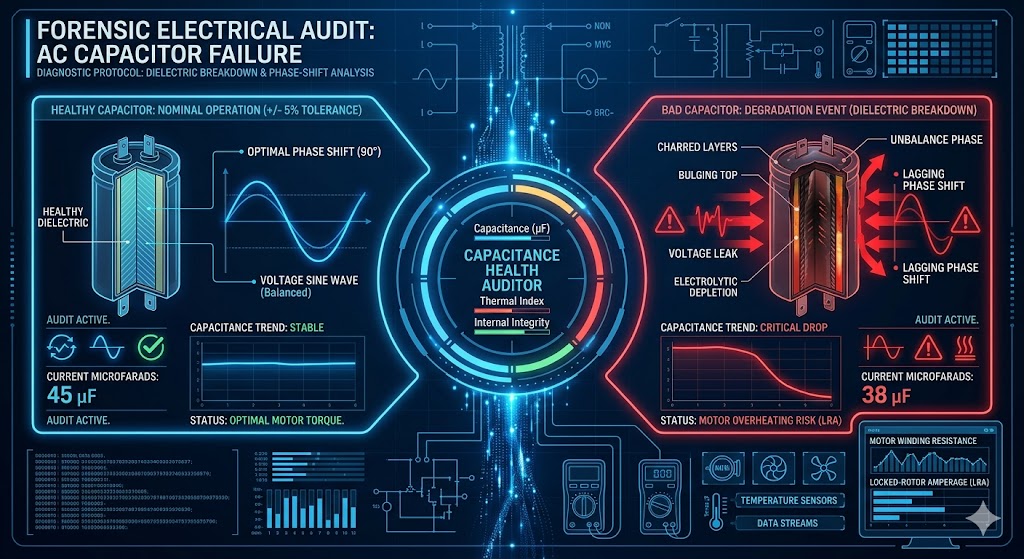
You know that your air conditioner has a capacitor inside. But do you also know what is the job of that capacitor inside your AC unit?
Well, the job of an AC capacitor is to help the air conditioner when it is starting up. The capacitor stores energy in it. When the AC is turning on, it provides an extra boost of electricity to your AC and helps the motor fan/compressor to reach its maximum speed. This helps your air conditioner to start smoothly.
Once the job is done, the capacitor stops its function goes to rest until your start your air conditioner again the next time.
What causes the air conditioner capacitor to go bad?
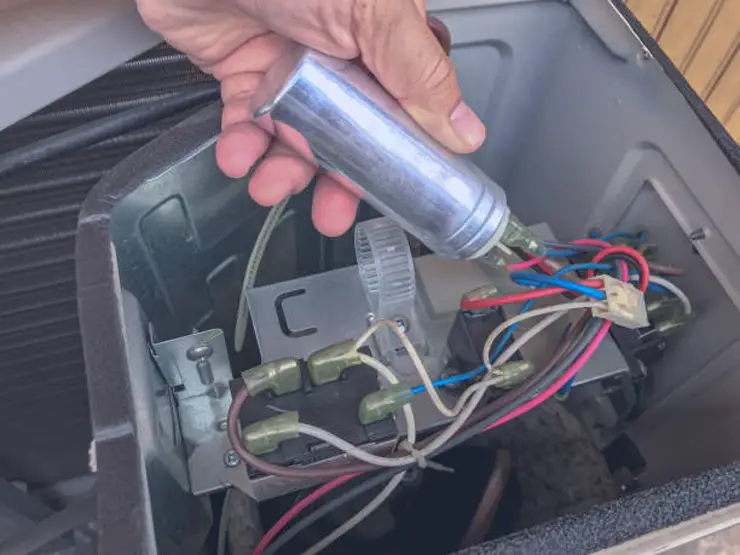
If the capacitor of your air conditioner has gone bad, then you must be wondering what are the possible reasons behind that?
Well, here are all the reasons that cause an air conditioner capacitor to go bad:
Physical damage
One of the most common reasons why the capacitor of your air conditioner goes bad is physical damage.
If the capacitor of your AC unit has been physically damaged due to some reasons like debris hitting the unit, then it will surely stop working normally.
Therefore, you can look for any signs of physical damage to the capacitor of your AC.
Lightning strike
If there has been a lightning strike on your house, then the intense power surge will damage the capacitor of your air conditioner unit.
Due to overheating
The capacitors of your air conditioner are very sensitive to overheating.
If your air conditioner is installed on a rooftop or somewhere else where it is exposed to sunlight, then the high temperature and overheating will damage the capacitor. Especially in summer, it is more likely to happen.
Similarly, electrical overheating is also one of the main reasons. If your air conditioner is working too hard for too long then it will get electrically heated and its capacitor will stop working.
Fluctuation in voltage
The capacitor of your air conditioner has a specific voltage rating. It can get damaged due to fluctuations in the voltage.
If there is a power surge and the voltage is too much (more than what your capacitor needs), then it will destroy the capacitor of your air conditioner and it will stop working.
Similarly, if there’s a voltage fluctuation and the voltage becomes too low, then it will also have a damaging impact on the capacitor of your air conditioner and it may stop working.
Wear and tear
When you use a machine for so long and so much time, then it is bound to break down due to wear and tear.
The same is the case with the capacitor of your air conditioner.
If you have been excessively using it for so long then it might break down due to wear and tear.
Age of capacitor
Capacitors have an age. Their ability to store and release electrical energy starts declining with time.
An AC capacitor can’t keep working forever. It will eventually stop working once it has completed its life.
What happens when the AC capacitor goes bad?
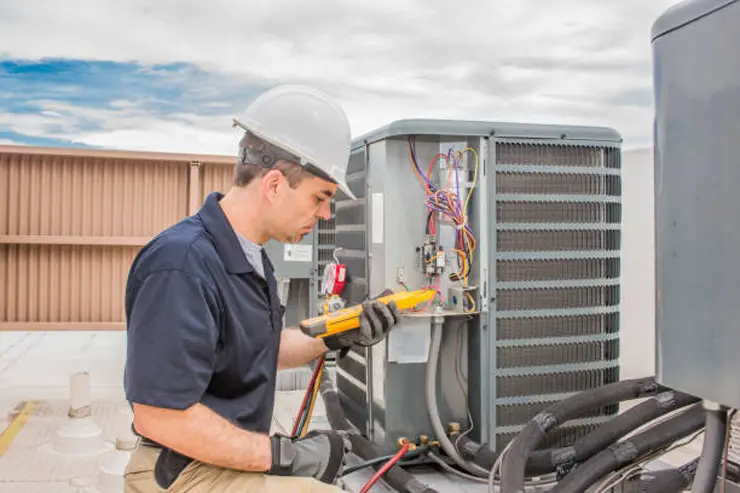
When the capacitor of your AC unit goes bad, the air conditioner starts struggling with the hard start problem.
When the AC is starting up, it needs 4-8 times more energy than it needs to keep running.
The job of a capacitor is to provide that extra energy boost to the AC when it is starting up.
When the capacitor will go bad, then the air conditioner does not get that extra energy boost which helps it to start smoothly.
Hence, your AC will have problems while starting up.
How often do AC capacitors go bad?
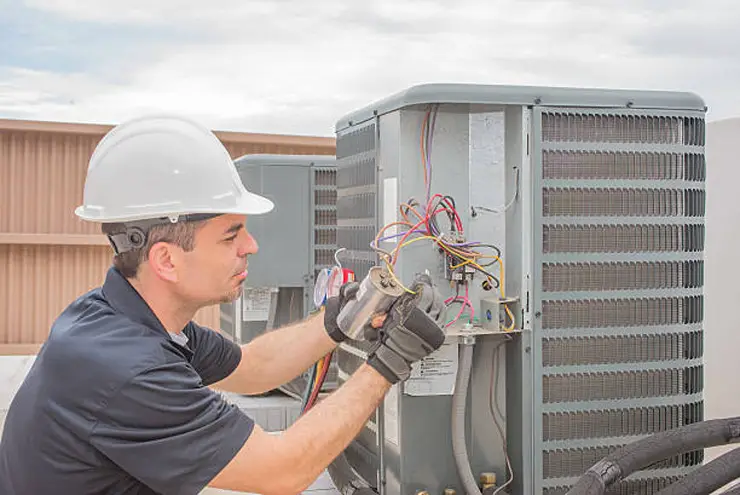
Usually, the capacitors of air conditioners do not go bad much frequently.
If the capacitor remains protected from all the threats, then it will have a very long life which is up to 20 years.
However, the life of the capacitor can be decreased by a lot of factors such as voltage fluctuation, lightning strike, power surge, overheating, wear and tear, electrical overload, etc.
These threats can destroy the capacitor or decrease its life significantly.
How long do AC capacitors last?
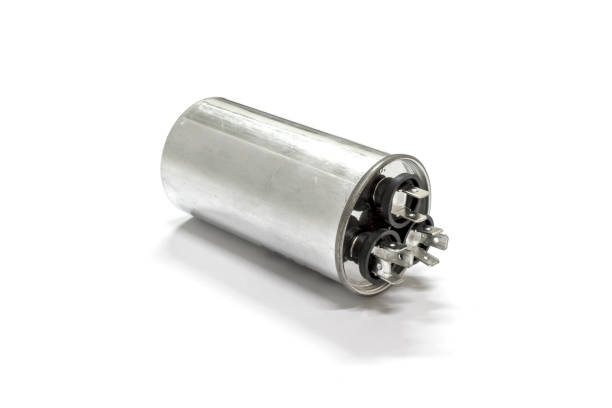
You must be wondering how long does an AC capacitor last?
Well, AC capacitors can last for 10 to 20 years if they remain protected from all kinds of threats.
However, many threats can destroy the capacitor of your AC way before its actual life such as electrical overload, voltage fluctuations, overheating, wear and tear, etc.
If the capacitor of AC faces any of these threats, then it can get damaged and go bad earlier than its usual life.
Will AC run with a bad capacitor?
No, your AC might not run normally with a bad capacitor.
It will most likely develop hard start problems.
💡 Engineering Insight: In many cases, a “bad” capacitor is just the first symptom of a larger electrical issue, such as a loose neutral wire or a failing contactor. Use our AC Troubleshooting Protocol to perform a full forensic audit of your electrical cabinet before installing a new unit.
How to tell if the AC capacitor is bad?
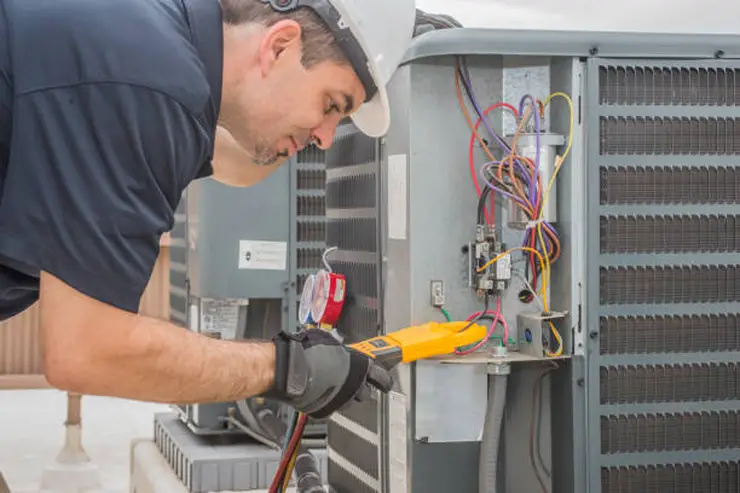
If your AC capacitor has gone bad, how can you find that out?
Well, there are many symptoms which tell that the capacitor of your AC is bad:
Bad AC capacitor symptoms
Hard start problem
If your air conditioner is struggling while starting up then it means that the capacitor is not working fine.
This is called a hard start problem.
Chemical leak
If you have observed any chemical leak coming out of your air conditioner then it means that the capacitor is bad.
Smoke
If your air conditioner unit is giving out smoke that has an acidic smell then it is a huge sign that there is something wrong with the capacitor.
Shutting off
If your air conditioner unit randomly shuts off (especially after you switch it on) then it indicates a capacitor problem.
No cold air
If your AC unit is not blowing any cold air while working then it means that there is something wrong with the capacitor.
Humming sound
If your AC is giving out humming sounds then it indicates a capacitor problem.
Not turning on
If your air conditioner is not turning on then it means the capacitor of the AC is not working normally.
High energy bills
If your energy bills are increasing without any explanation then it also means there is a capacitor problem.
💡 Pro Diagnostic Tip: A humming sound without the fan spinning is a textbook sign of a failed start circuit. If you have confirmed a failure, do not leave the power on, as this will burn out the motor windings. Check our Step-by-Step Capacitor Replacement Guide to learn how to safely discharge and swap the component.
Do air conditioner capacitors have a shelf life?
Yes, air conditioner capacitors have a shelf life.
Experts say that ac capacitors might have a shelf life of 2 to 10 years.
You should keep them in a controlled and suitable environment if you want a longer life.