In the HVAC industry, there is a significant difference between “swapping a unit” and System Commissioning. While a technician can physically mount an air conditioner in under two hours, a professional installation—one that protects your investment for 15+ years—requires a specific sequence of engineering phases.
If a contractor tells you they can be “in and out in three hours,” they are likely bypassing the most critical stage of the process: the Vacuum Decay Test. This guide breaks down the forensic timeline of a proper installation.
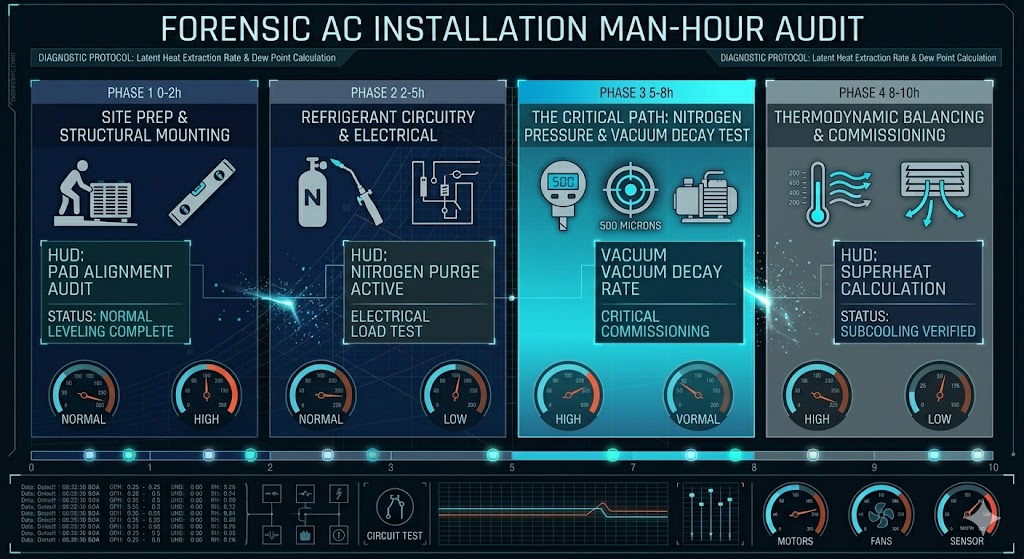
The 4-Phases of Forensic Installation
Phase 1: Structural Mounting & Placement (1–2 Hours)
This involves the physical placement of the indoor evaporator coil and the outdoor condenser.
- Forensic Detail: We audit the leveling of the outdoor pad and the pitch of the indoor drain pan. An unlevel unit causes uneven oil distribution in the compressor, leading to premature mechanical failure.
Phase 2: Refrigerant Circuitry & Electrical (2–3 Hours)
This is the “plumbing” of the system. We braze the copper line sets using a Nitrogen Purge.
- Why it takes time: Brazing without nitrogen creates “soot” inside the pipes. This soot eventually clogs the expansion valve. A forensic install ensures the internal pipes remain as clean as the day they were manufactured.
Phase 3: The Critical Path – Vacuum & Micron Testing (2–3 Hours)
This is where cheap installs fail. We must remove all air and moisture from the lines.
- The Standard: We do not guess. We use a digital micron gauge to pull the system down to under 500 microns.
- The Physics: Moisture reacts with refrigerant oil to create hydrofluoric acid. If this phase is rushed, your “new” system is already dying from the inside on day one.
Phase 4: Thermodynamic Balancing & Commissioning (1 Hour)
The final stage isn’t just turning it on. It’s about measuring the Superheat and Subcooling to ensure the refrigerant charge is perfect for your specific home’s layout.
DIAGNOSTIC: INSTALLATION TIMELINE CALCULATOR
Select your installation type to see the required engineering man-hours:
A professional installation ensures the drain lines are pitched correctly. If you notice water pooling shortly after a new install, consult our guide on How Much Water Should Drain from an AC to verify the extraction rate.
If your newly installed system is cycling on and off rapidly, you may have a commissioning error. Use our AC Troubleshooting Protocol to audit the thermostat and sensor placement.