If you have ever driven a Model Y or Model 3 during a blistering summer or a freezing winter, you already know the answer to the question: How good is Tesla air conditioning? It is exceptionally powerful. But the real magic isn’t in how cold it gets—it is in how it operates.
Unlike traditional vehicles or standard residential air conditioners that waste massive amounts of energy, modern Teslas utilize a revolutionary piece of engineering called the Octovalve and Super Manifold Heat Pump. Instead of just venting hot air outside, the Tesla system actively “scavenges” waste heat from the car’s battery and electric motors to heat the cabin, or intelligently reverses the flow to cool it, operating at a Coefficient of Performance (COP) that makes traditional HVAC units look prehistoric.
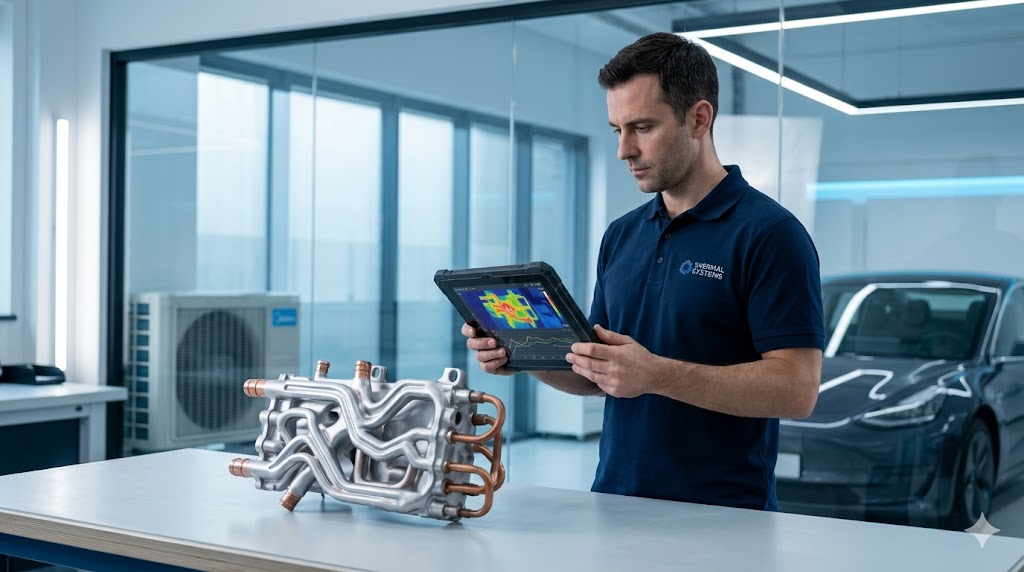
With constant rumors of Tesla releasing a home HVAC system, how does their car technology actually stack up against premium residential VRF (Variable Refrigerant Flow) systems like Mitsubishi or Daikin?
Use our Interactive Tesla vs. Residential HVAC Simulator below. Select your outside weather conditions to see exactly how the Tesla Heat Pump manages thermal energy compared to a standard home air conditioner.
Select the outside weather to see how thermal energy is managed.
The Inverter Advantage
While most people think Tesla invented the variable-speed compressor, this technology has been the gold standard in high-end residential units for years. If you are experiencing issues with your home system’s inverter, you can troubleshoot the specific board faults using our technical guides for LG Inverter ACs and Samsung Digital Inverter units.
Heat Scavenging and Reliability
The Octovalve’s ability to move heat from the battery to the cabin is essentially a high-tech version of a residential heat pump reversing valve. However, mechanical failures in these pathways are common across all brands. If your home system has stopped heating or cooling entirely, check our guide on what causes an AC compressor to stop working to see if it’s a simple capacitor fix or a terminal failure.
📊 2026 Engineering Benchmarks: Tesla vs. Residential HVAC
| Metric | Tesla Octovalve (Heat Pump) | Premium Residential VRF (e.g. Mitsubishi) | Standard Residential Split (e.g. York) |
| Peak $COP$ | Up to 5.2 (Mild Conditions) | Up to 4.8 (Inverter Driven) | ~3.2 to 3.8 (Non-Inverter) |
| Max $EER$ | 14 – 16 | 12 – 15 | 8 – 11 |
| Low Temp Performance | Active Scavenging (Down to -30°C) | Vapor Injection (Down to -25°C) | Fails / Electric Heat (Below 0°C) |
| Heat Source | Ambient, Battery, & Motors | Ambient Air Only | Ambient Air Only |
| Coolant Type | Glycol + Refrigerant | Refrigerant Only | Refrigerant Only |
| Control Logic | AI-Driven Predictive Thermal | PID Loop / Sensor Driven | Fixed Thermostat Logic |