There is nothing worse than surviving a heatwave only to realize your air conditioner is blowing warm air because the outdoor compressor has stopped working. Whether your unit is completely dead, making a strange buzzing noise, or short-cycling every few minutes, a failed compressor is an HVAC emergency.
The compressor is the “heart” of your air conditioning system, responsible for pumping refrigerant between the indoor and outdoor coils. When it stops, cooling stops. However, a silent compressor does not always mean the compressor itself is dead. Often, a $20 electrical component like a run capacitor is to blame.
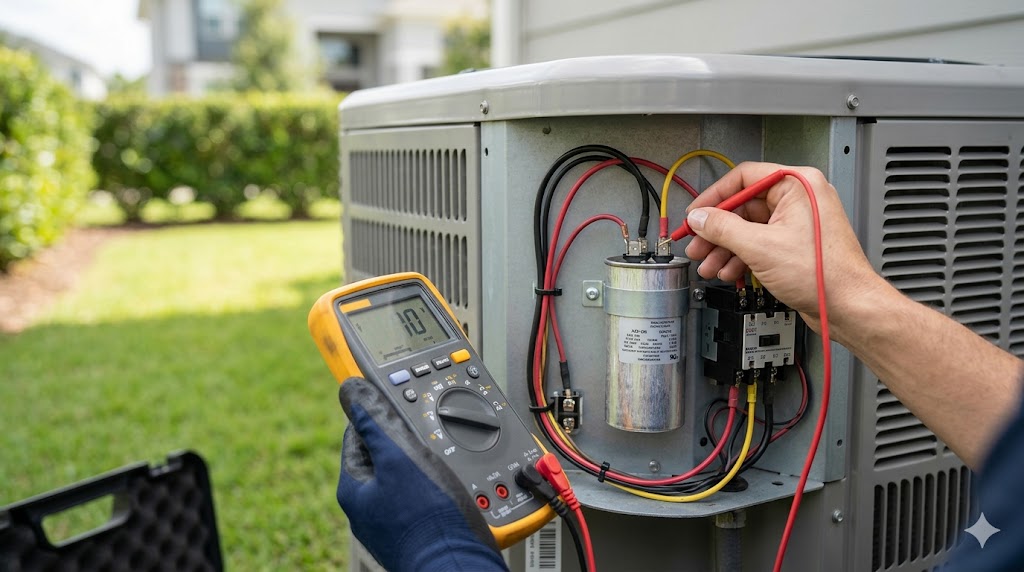
Before you call a technician or assume the worst, use our Interactive Compressor Triage Tool below. Select the exact symptom your outdoor unit is displaying to instantly diagnose the most likely culprit.
What symptom is your outdoor AC unit displaying right now?
Top 5 Reasons Your AC Compressor Stopped Working
If the interactive tool above didn’t solve your mystery, or if you want to understand the mechanics behind the failure, here are the top five culprits behind a dead compressor.
1. A Dead Run Capacitor (The Most Common Culprit)
Over 70% of “dead compressor” service calls end up being a failed capacitor. The capacitor acts like a heavy-duty battery that gives the compressor the massive jolt of torque it needs to start. When it fails, the compressor will try to start, make a loud humming or buzzing noise, and then shut down due to thermal overload. Never let a unit hum for long periods, as this can permanently destroy the compressor.
2. Tripped High-Pressure or Low-Pressure Switches
Modern air conditioners have built-in safety switches. If your outdoor coils are caked in dirt, the system cannot release heat, causing internal pressure to skyrocket and triggering the high-pressure switch. Conversely, if your system has a Freon leak, the low-pressure switch will shut the compressor down to prevent it from running dry (since refrigerant also cools the compressor motor).
3. A Burnt Magnetic Contactor
The contactor is a mechanical relay switch inside your outdoor unit. When your thermostat calls for cold air, a low-voltage signal is sent to the contactor, snapping it shut and allowing 240 volts of electricity to reach the compressor. Over time, bugs, dirt, or electrical arcing can burn the contactor points, preventing the voltage from passing through.
4. Internal Inverter Module Failure
If you own a modern variable-speed inverter system, the “brain” controlling the compressor is much more complex than a standard unit. Voltage spikes or heat can destroy the Intelligent Power Module (IPM) on the outdoor circuit board. If you have an advanced system, you can diagnose this by checking your unit’s error codes:
- Midea ACs will flash a P0 Code for IPM malfunction.
- Trane Systems will display an H5 Code for inverter lockout.
- LG Air Conditioners will show a CH21 Code for a DC power overcurrent.
- Mitsubishi Units will flash a U6 Code indicating compressor overcurrent.
5. Hard Electrical Shorts and Locked Rotors
The worst-case scenario is a mechanical or electrical failure inside the hermetically sealed compressor shell. “Locked rotor” means the mechanical pistons or scrolls inside the compressor have seized up due to a lack of lubrication or wear. A “short to ground” means the electrical windings inside the motor have melted and are touching the copper casing. In either of these scenarios, the compressor must be fully replaced.
When to Call a Professional
Checking your thermostat batteries, washing your outdoor coils, and looking for blinking error codes (like Samsung’s LED light combinations) are great first steps. However, opening the electrical panel of an outdoor AC unit exposes you to high-voltage capacitors that hold a lethal electrical charge even when the power is turned off at the breaker. Always rely on a licensed HVAC technician to replace capacitors, contactors, and compressor motors.