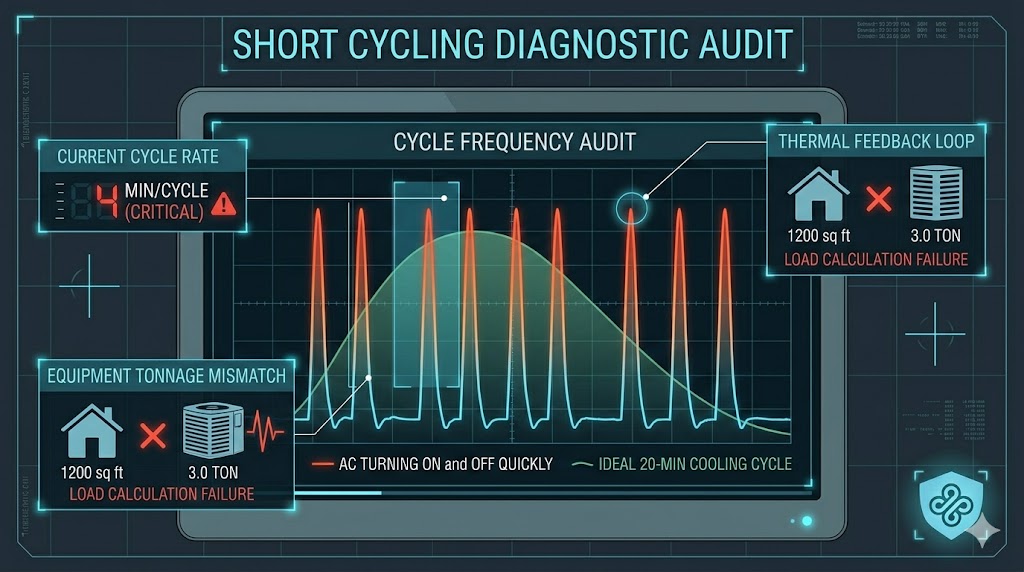
When an air conditioner cycles too frequently—a phenomenon known as Short Cycling—it is not merely an inconvenience; it is a Cycle Rate Violation. In a properly engineered environment, an AC system should run for at least 15–20 minutes to achieve thermodynamic equilibrium and proper dehumidification. If your unit terminates its cooling cycle in under 10 minutes, your system is under extreme mechanical stress.
1. The Mechanics of a Cycle Rate Violation
Short cycling occurs when the cooling cycle is terminated prematurely before the space reaches the desired thermodynamic setpoint. This leads to:
- Compressor Fatigue: High-amperage startups occur more frequently, shortening the lifespan of the motor.
- Humidity Spikes: The system shuts off before it can remove moisture from the air, leaving the room “cold and clammy.”
- Energy Inefficiency: AC units are least efficient during the first 5 minutes of a cycle.
2. Forensic Cause: Short-Circuiting Airflow
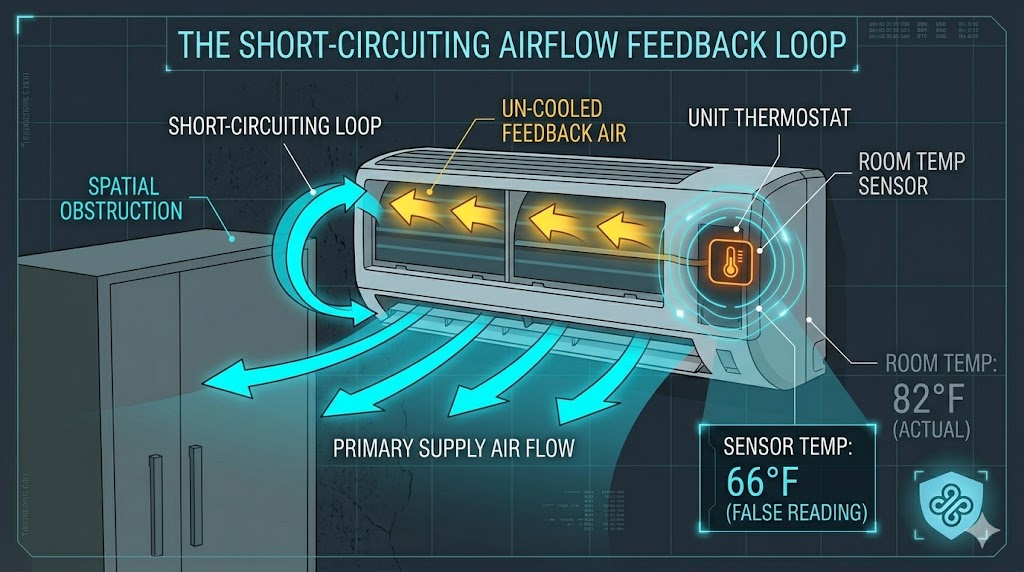
One of the most common installation failures is poor vent placement. If a supply vent is placed too close to the return air intake, the cold air “short-circuits.”
The cold air leaves the vent, hits a nearby obstruction (like a cabinet or wall), and is immediately sucked back into the unit’s intake. This tricks the internal thermostat into thinking the room is cooled, causing the system to shut down while the rest of the room remains hot.
3. Engineering Failure: Equipment Over-Sizing
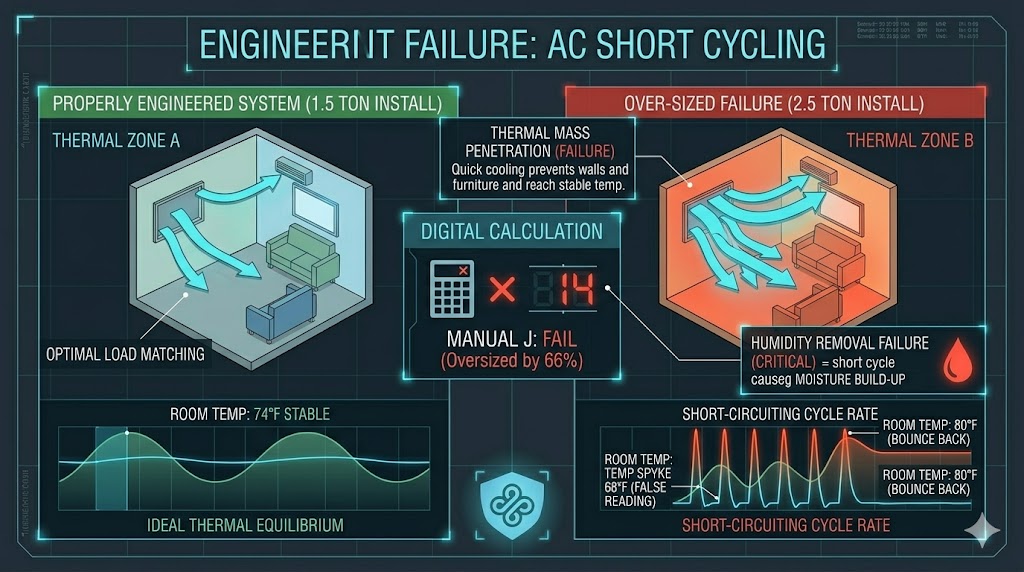
Many installers believe “bigger is better” and install a high-tonnage unit in a small space. This is a failure of the Manual J Load Calculation.
- The Symptom: The unit reaches the temperature setpoint almost instantly and shuts off.
- The Result: The walls and furniture never have time to release their heat, causing the air temperature to bounce back up within minutes, triggering another rapid start.
4. Diagnostic: Cycle Frequency Audit
Use the tool below to determine the severity of your system’s cycle rate.
DIAGNOSTIC: CYCLE FREQUENCY AUDIT
How long does your AC run before it shuts off?
5. The Maintenance Link: Thermal Evaporator Integrity
Short cycling can also be a secondary symptom of a Frozen Evaporator Coil. When ice builds up on the fins, airflow is restricted, causing the high-pressure switch to trip and shut down the compressor to prevent a liquid slugging event.
If you notice ice on your lines, cross-reference this with our Frozen AC Thermal Protocol immediately.
6. Technical Intervention Checklist
DIAGNOSTIC: STATIC PRESSURE AUDIT
Select your manometer reading (Inches of Water Column):
Note: Audit based on Total External Static Pressure (TESP) standards.
If your audit indicates a “Critical” status, the following forensic steps are required:
- Verify Thermostat Placement: Ensure it is not near a heat source or directly in the path of a supply vent.
- Audit Static Pressure: Check for restricted filters or undersized ductwork that may be causing the high-limit switch to trip.
- Check Refrigerant Levels: Low “gas” levels can cause the low-pressure switch to cycle the compressor on and off rapidly. Follow our Gas Leakage Diagnostic Audit for pressure testing protocols.
Engineering Standard
Proper cycle timing is established during the commissioning phase of a professional installation. As detailed in our Installation Man-Hour Audit, accurate load matching (Manual J) is the only way to prevent chronic short-cycling and ensure system longevity.