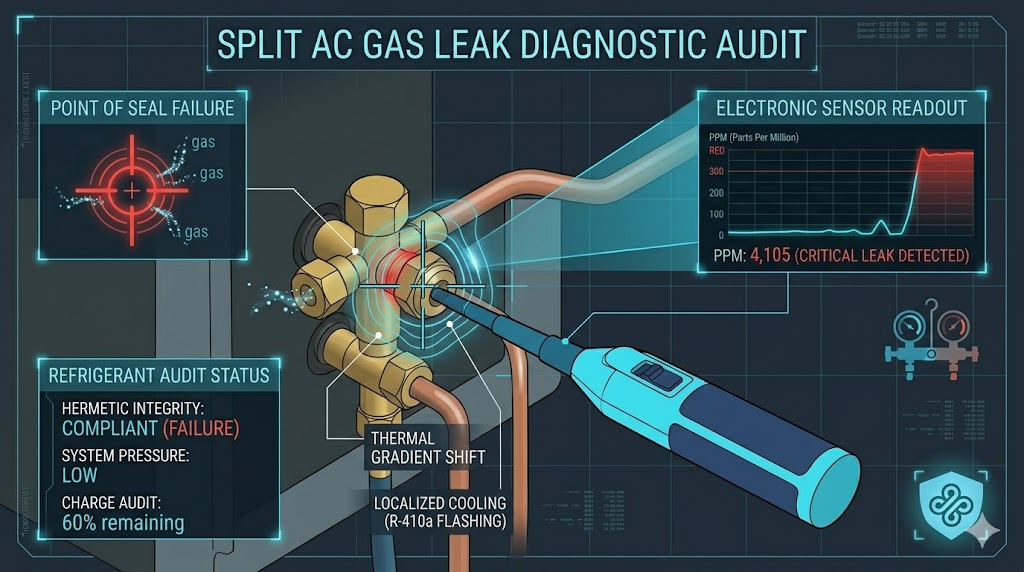
In a professional HVAC installation, the refrigerant circuit is a 100% hermetically sealed environment. Any loss of ‘gas’ (refrigerant) is a symptom of a mechanical failure in the flared fittings, brazed joints, or the evaporator coil itself. Identifying a leak is an exercise in Thermodynamic Auditing—measuring where the pressure-temperature relationship has broken down.
DIAGNOSTIC: LEAK SEVERITY AUDIT
Select your primary system symptom:
1. Dye Test
A dye test is one of the easiest ways to check if your system has a gas leak. With this process, you just need to send fluorescent dye in your unit. Once it has circulated, the dye will then pour through any existing leaks.
You will then use a detection lamp to scan your system and identify the areas where the dye leaked out. The process will only take a few minutes but you might need some specialized equipment for this. This is why this test is often best left to the hands of professionals.
2. Electronic Device Detection
With the use of an electronic device, you just scan across the components of your air conditioner. Once the electronic device detects a leak, an alarm will go on so you can identify the specific location.
The only problem with ac gas leak detector is that it only identifies leaks in certain areas where the detector touches the parts of the unit. Also, these devices are quite expensive and you need some training to learn how to use them properly.
3. Nitrogen Leak Detector Test
While soap bubbles are a common DIY check, the Nitrogen Pressure Audit is the professional engineering standard. We isolate the refrigerant circuit and pressurize it with dry nitrogen to 350–400 PSI. By monitoring the system with a digital manifold over a 24-hour period, we can verify the Hermetic Seal Integrity. If the pressure holds steady, the installation is sound; any drop indicates a structural failure in the brazing or flared fittings that requires mechanical repair before recharging.
4. Soap Bubble Test
If hiring a professional is out of the question, you can also detect leaks using the soap bubble test. All you need here is warm water and soap. Mix the solution for a few minutes. Once you have stirred it enough, send the solution through your unit.
You will see air bubbles if your system has leaks. Mark off the areas so it will be easier for the technician to identify where patches are needed. Just make sure you no corrosive elements are added to the air bubble mix as these can wear down the components of your unit that might lead to costly repairs.
5. Oil Detection
If your split AC has a gas leak, oil will leak out as well sometimes. It is quite easy to detect the substance because of its dark and thick consistency. There is also a distinct and potent odor that you can smell even at a distance. If you suspect that your unit has a leak, use protective gloves to feel around its parts.
Check your gloves for any visible traces of oil. You need to get the unit repaired right away if there is a lot of oil produced. You can also use a light colored cloth if you don’t have protective gloves. Use these tips on how to check gas leak in split AC so you can get it repaired before it is too late.
Engineering Correlation
A significant percentage of refrigerant leaks are the direct result of rushed commissioning during the installation phase. As documented in our Forensic Installation Man-Hour Audit, skipping the Phase 3 Nitrogen Pressure Test is the leading cause of premature hermetic seal failure.