Measuring ductwork is about more than just ensuring the metal pipes fit in your attic; it’s about calculating the CFM (Cubic Feet per Minute) capacity of your entire home. Most “low cooling” complaints are actually caused by ductwork that is physically too small for the tonnage of the air conditioner. When air cannot move freely, static pressure builds up inside the system, acting like a “clogged artery” that forces the blower motor to pull more amps and generate excess heat.

If you are upgrading to a high-efficiency variable-speed unit, your old ductwork may be your biggest bottleneck. These modern systems require precise airflow paths to function. Simply measuring the diameter of a flex duct isn’t enough—you must calculate the Available Static Pressure to ensure you aren’t about to suffocate your new investment.
Before you start cutting sheet metal, use the Ductwork Capacity Auditor below. This tool will cross-reference your unit’s tonnage with your duct dimensions to tell you if your current system is “choking” or “breathing.”
Step-by-Step: How to Measure Existing Ductwork
Measuring your existing runs requires identifying the “Trunk” (the main artery connected to the indoor air handler) and the “Branches” (the smaller lines running to individual vents).
Measuring Rectangular Sheet Metal Trunks
Rectangular metal ducts are standard in older homes and basements. To find the cross-sectional area:
- Measure the exact width of the duct in inches.
- Measure the exact height of the duct in inches.
- Multiply the two numbers together (e.g., 16″ width x 8″ height = 128 square inches).
Note: The insulation wrapped around the outside of the duct does not count toward the internal airflow volume. Always measure the hard metal edge, or subtract the thickness of internal acoustic lining if present.
Measuring Round Flex Ducts
Flexible ductwork is commonly used in attics for branch lines. Because it is round, you are measuring the diameter.
- Do not measure the thick, puffy fiberglass outer jacket.
- Compress the insulation slightly to find the rigid inner wire core.
- Measure straight across the center of the inner core. Common sizes are 6″, 8″, and 10″ diameters.
The Friction Rate: Why Duct Material Matters
A 10-inch round sheet metal pipe and a 10-inch round flex duct do not carry the same amount of air. The interior surface of your ductwork heavily influences the friction rate.
Rigid sheet metal is smooth, allowing air to glide with minimal resistance. Flexible ductwork, however, has a corrugated, ribbed inner core. As air travels over these ridges, it tumbles and creates turbulence, drastically reducing the effective CFM.
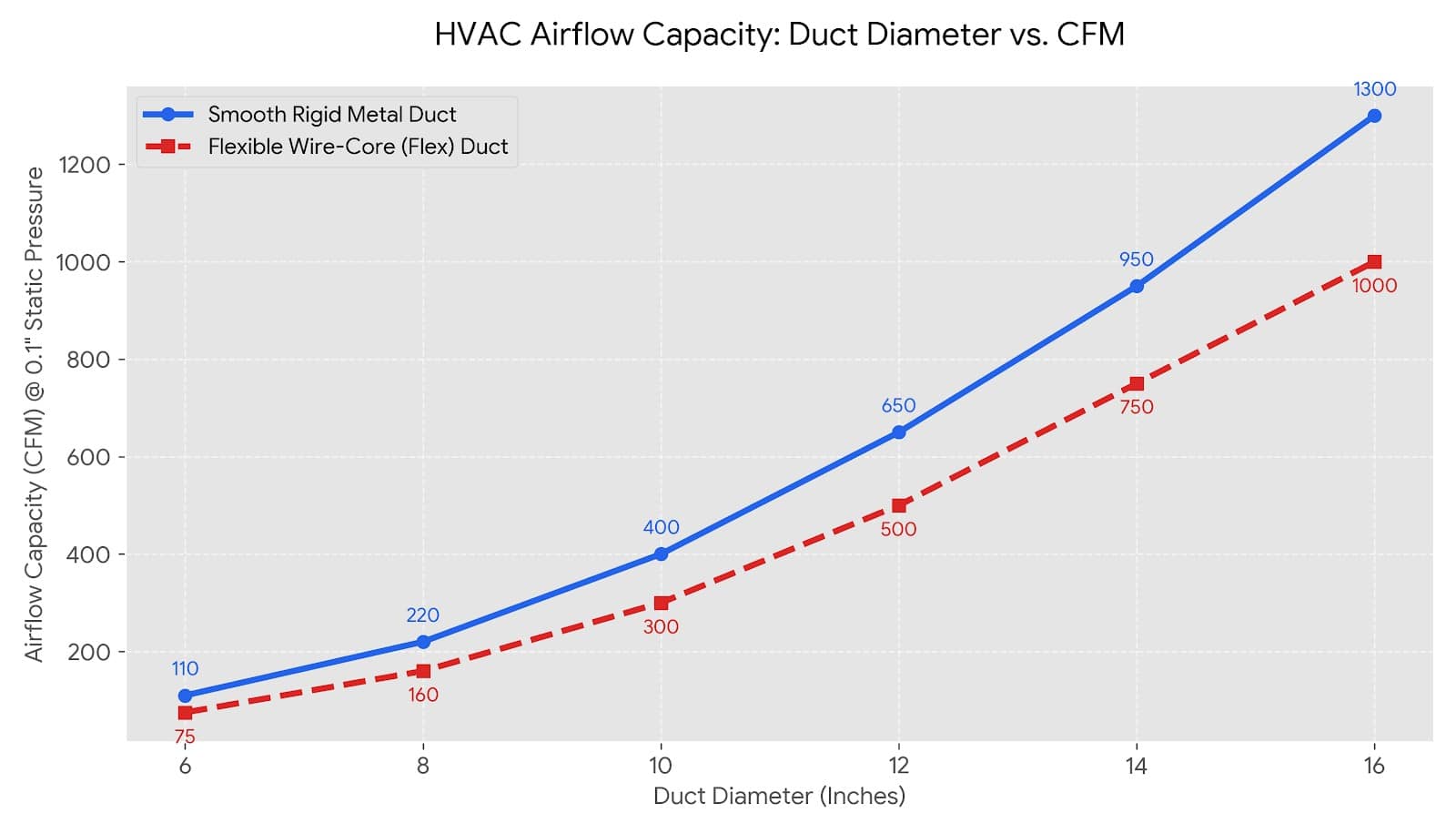
Insight: If your home was originally sized for metal ducts but was repaired with flex duct without increasing the diameter, your system is likely operating at 20% lower efficiency than intended.
Material Friction & Airflow Capacity Comparison
(Based on a standard 10-inch diameter duct at 0.1″ static pressure)
| Duct Material Type | Interior Surface | Max Airflow Capacity (CFM) | Best Use Case |
| Rigid Sheet Metal | Smooth | ~400 CFM | Main trunk lines, long horizontal runs |
| Hard Fiberglass Board | Semi-Smooth | ~360 CFM | Plenums, short transitions |
| Flexible Wire-Core | Corrugated (Ribbed) | ~250 CFM | Short branch lines (under 15 feet) |
Warning: If flex duct is installed poorly—meaning it is sagging, kinked, or bent at sharp 90-degree angles—its CFM capacity drops by an additional 30% to 50%.
Diagnosing Airflow Obstructions & Sizing Issues
Before tearing out your ductwork, ensure you are accurately diagnosing a sizing issue rather than a maintenance failure. The symptoms of undersized ducts—whistling return vents, frozen evaporator coils, and hot/cold spots in the house—are identical to the symptoms of severe neglect.
Airflow measurements are only accurate if the path is clear. An undersized duct is bad, but a clogged filter makes it fatal. Check our guide on how to clean your aircon filter to ensure your manual measurements aren’t being skewed by a wall of pet hair and debris blocking the intake.
Sizing the Main Trunk vs. Branch Lines
A properly designed duct system acts like a tree. The main trunk connected to the air handler must be large enough to carry the full CFM load (e.g., 1,600 CFM for a 4-ton unit). As branch lines split off to feed individual rooms, the main trunk should step down in size to maintain consistent velocity.
If your ductwork is sized correctly but your home still isn’t cooling, the issue might be the capacity of the unit itself. Pushing 1,000 CFM of air into a massive open-concept living room won’t help if the air isn’t cold enough to offset the thermal load. Verify your room’s requirements by checking what a BTU is according to the DOE standards to ensure your equipment has the raw cooling power required for your square footage.
Final Verdict: When to Call a Professional
If your Ductwork Capacity Audit reveals that your main trunk line is drastically undersized for your AC tonnage, do not attempt a DIY modification. Increasing airflow requires advanced Manual D (duct design) calculations. A certified HVAC technician will need to use a digital manometer to measure the Total External Static Pressure (TESP) and strategically expand the supply plenum to safely accommodate the required CFM without unbalancing the rest of the house.