If you have noticed your skin becoming increasingly dry, irritated, or prone to sudden breakouts after spending all day in a climate-controlled office, you are probably wondering: Does AC cause pimples? The answer is a complex yes. While the air conditioner itself doesn’t “infect” your skin with acne, it creates an environmental catalyst for breakouts. Air conditioners act as massive dehumidifiers; as they cool the air, they strip away the essential moisture your skin needs to maintain its protective barrier.
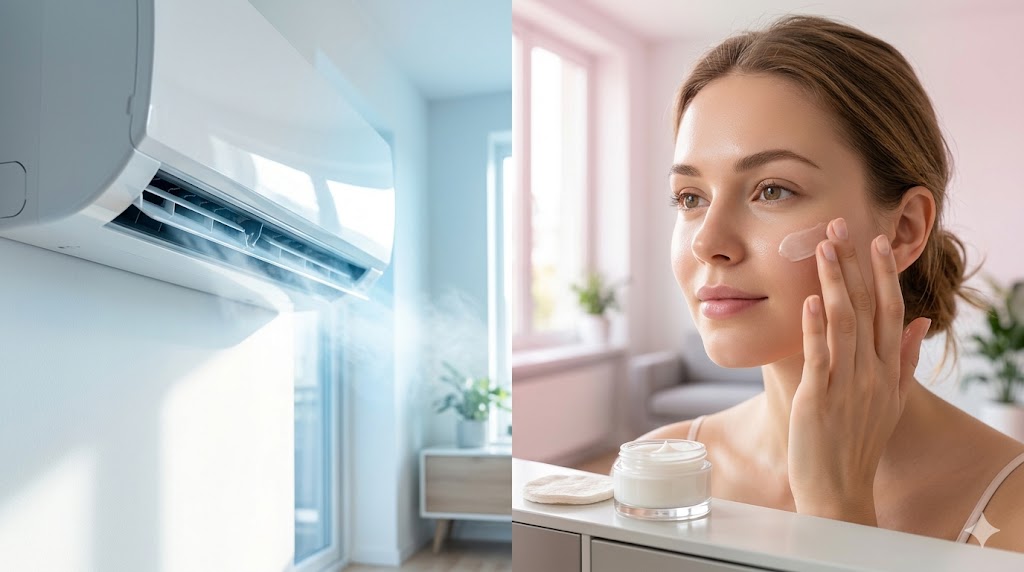
When your skin becomes overly dry (a process known as Transepidermal Water Loss), your sebaceous glands go into “panic mode,” overproducing oil (sebum) to compensate. This excess oil, combined with the recycled dust and bacteria trapped in poorly maintained AC vents, creates the perfect recipe for clogged pores and “AC Acne.”
Before you change your entire skincare routine, use our Interactive Skin-Type AC Risk Calculator below to see how your specific environment is impacting your complexion.
Analyze how your AC environment is affecting your skin’s health.
The Role of Dirty Filters and Bacteria
Beyond just drying out your skin, a poorly maintained air conditioner acts as a distribution system for biological contaminants. If your system hasn’t been cleaned in months, the dust trapped in your vents becomes a breeding ground for bacteria that can trigger inflammatory acne. If you notice a musty smell alongside your breakouts, your unit might be harboring fungal growth. Check your home’s status with our AC Mold Risk Calculator.
Optimizing Your Environment
Modern inverter air conditioners are actually better for your skin because they don’t ‘flash-dry’ the air like older systems. Because they run at lower, constant speeds, they maintain a more stable humidity level. To see how these systems manage airflow differently, visit our guide on Inverter AC Logic.
How can air conditioning cause pimples?
By now, you know that dead skin cells are among the most frequent causes of pimples. The question is, how can air conditioning cause pimples? Or, how can such household appliances cause dead skin cells that contribute to the amounts of pimples in a person?
If you do any of these to your air conditioners, then, there are bigger chances for your air conditioners to cause pimples:
Setting the temperatures too cold
When you set your air conditioners’ temperatures, you should mind the temperatures in your outside environments as well. Normally, if your outside environments are already cold, you wouldn’t want to set your air conditioners’ temperatures cold as well.
For example, air conditioners with 16-20 degrees Celcius temperatures are normal when the outside environments’ temperatures are somewhere between warm, sunny, and hot. The “borderline” air conditioner temperature is 22 degrees Celcius and can be used when the outside environments’ temperatures are normal.
If you set your air conditioners’ temperatures below the standards, there are bigger risks for dry skin. Since dry skin causes dead skin cells, it is highly possible to get pimples or acne.
Not placing any humidifiers beside your air conditioners
Humidifiers are electric household appliances that are small in size and have the role of increasing the moisture levels in a room. Placing them beside your air conditioners will not only make them “do the jobs”, but also purify the qualities of the airs produced by your air conditioners.
So, the lesser you place your humidifiers beside your air conditioners, the less likely you will breathe fresh air from your air conditioners. This thing can impact your skin.
By inhaling and exhaling lesser-quality air, your skin won’t feel relaxed. As a result, skin problems such as dry skin or the appearance of whiteheads and blackheads can emerge.
Not setting the wind power right
Temperatures are not the only things that matter in an air conditioner. Many air conditioners these days have features in adjusting the wind power: How strong the wind should be, how many degrees of the wind rotation, and more – you name it.
Failing to set the wind power right can cause many negative things to happen. The simplest yet one of the most dangerous things to happen is the flying strands of hairs. Not only that they can cause your rooms to be dusty.
As a result of the dusty rooms, you will also have difficulties in maintaining your skin’s health. If you don’t take immediate action, skin problems such as pimples may arise at any time.
Tips to prevent your air conditioners to cause pimples
The good news is that there are still ways for you to prevent your air conditioners to cause pimples. So, it’s possible to have the ideal temperatures of air conditioners while maintaining your skin’s health. Here are they:
Adjust the temperatures and the wind power accordingly
Don’t set your air conditioners super-cold if the outside’s environments are super-cold too. The same thing applies to super-hot environments: Don’t turn off your air conditioners if the outside environments are scorching hot.
No matter what the outside environments are, you should always refrain from setting the wind power to directly touch your bodies. Instead, adjust the wind degrees so they will touch other objects while maintaining the room’s moisture and coolness levels.
Place humidifiers around your air conditioners
Ideally, you should place at least two humidifiers: One on the left side and one on the right side. The humidifiers in diffuser forms are the most popular ones since diffuser-typed humidifiers will humidify not just the temperatures near the air conditioners but also the whole room. You can purchase humidifiers online or you can also make them by yourself.
Seek help from professionals
Seeking help from professionals who can handle problems with your air conditioners is also highly advisable.
Be sure to choose the right professionals to inspect what needs fixing in your air conditioners. That way, you will save yourself from getting skin problems due to the low quality of your air conditioners.
🧼 Maintenance Tip for Clear Skin: If you haven’t cleaned your AC filters in over 30 days, you are essentially blowing recycled skin cells and bacteria onto your face. Set a reminder to wash your filters every month to keep both your pores and your compressor healthy!
You may also want to know how to prevent hair fall due to air conditioner.