The “setback” strategy—turning your thermostat down 5 to 10 degrees at night—has been standard advice for traditional gas furnaces for decades. However, applying this same logic to a heat pump can be a mathematically expensive mistake. Unlike a furnace that delivers a blast of high-temperature air, a heat pump is designed for “steady-state” operation. It maintains temperature slowly and efficiently over long periods.
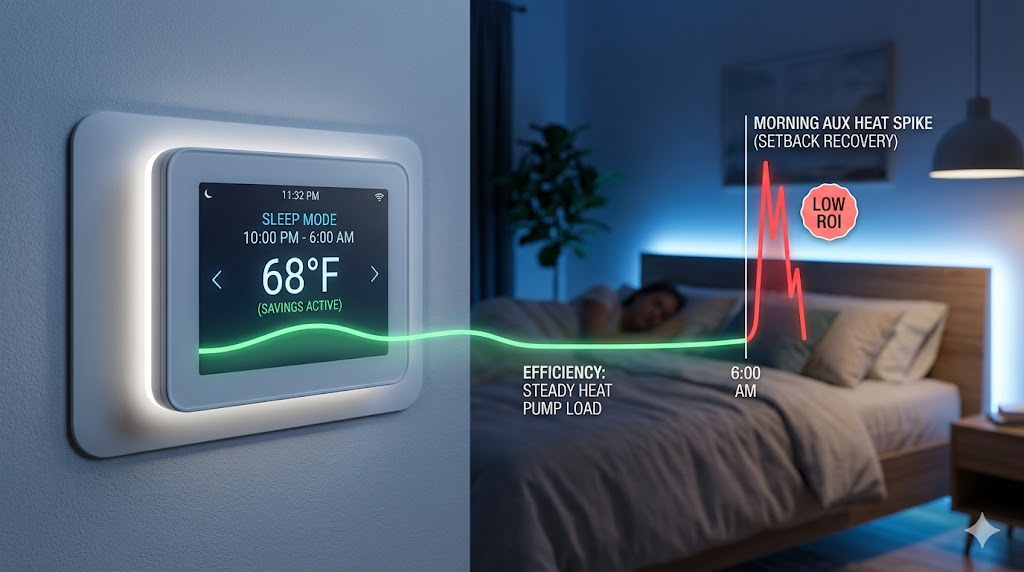
When you drop the temperature significantly at night, your heat pump faces a massive “Recovery Load” at 6:00 AM. To bridge the gap quickly, most thermostats will automatically engage Auxiliary Heat (electric resistance heat strips). These strips consume up to three times more electricity than the heat pump itself. In trying to save a few cents overnight, you may be spending several dollars in “Recovery” costs every morning.
To determine if your specific home and climate support a nighttime setback, use the Heat Pump Setback ROI Calculator below.
The “Diagnostic” Connection
If your heat pump struggles to recover even a small 2-degree setback, your system may be communicating an error through its indicator lights. Cross-reference your system’s behavior with our Heat Pump Light Flashing Guide to rule out a sensor lockout.
The “Hardware” Connection
Modern variable-speed systems are much better at handling recovery than older single-stage units. To see how your current brand compares in terms of efficiency and long-term operating costs, view our Rheem vs. Goodman 5-Year TCO Audit.
Should you turn down your heat pump at night?
No, you don’t have to turn down your heat pump at night. Yeah, I know a quality bed cover, especially the quilted ones, will give you the much-needed warmth overnight, but you shouldn’t turn down your heat pump overnight. This is because they are designed to work efficiently when working at a set temperature for a long duration.
If your intention of considering it is to reduce energy consumption, then you had better reconsider because your heat pump will require a lot of energy to turn back on.
Should I leave my heat pump on overnight?
Yes, you can leave your heat pump on overnight. Leaving your heat pump overnight at a regular level of temperature will ensure that they are working effectively. However, the more they work, the more energy they consume, so you might want to determine which is more economically wise for you in the long run.
Should I leave my heat pump on 24/7?
No, it is not economically wise to leave your heat pump on 24/7. As your heat pump will benefit from working on a steady temperature level for long hours, it is not advisable to leave them on all day. If your building is well insulated, the last thing you should worry about is a drastic drop in temperature due to turning down the heat pump
. Insulation will ensure that heat is retained within your indoor space for long hours. Therefore, you will be saving more energy by turning down your heat pump if they are not needed.
Should I turn off my pool heat pump at night?
No, you don’t need to turn off your pool heat pump at night. The purpose of using it for a pool is to keep the water warm; turning them off overnight will be counterproductive since the temperature usually drops at night.
If you are more concerned about the energy your heat pump will consume if left running overnight, I recommend putting them in a low-temperature setting instead of turning them off.
Your heat pump will consume a lot of energy when you turn them back on in the morning. Keeping them on will keep your heat pump working efficiently and keep your pool warm overnight.
What temperature should I set on my heat pump at night?
In the winter period, you can set your heat pump at 20 or 22°. If you are running it overnight, at this period, bring it down to 16 or 18° for peak performance.
What is the most efficient way to use a heat pump?
To keep your heat pump running optimally, make sure they run at a steady temperature (preferably low temperature) for long durations per day. Turning them off to bring down the cost of running is not the best option to keep them working efficiently.

Is it okay for a heat pump to run all night?
Yes, it is okay to run your heat pump all night. There are divided thoughts regarding whether or not it is okay to leave the heat pump running overnight. With both sides have cogent points to back their claim.
So either way, you will benefit from the outcome. It is okay for you to leave your heat pump running all night as long as it is running at a low temperature.
How much should you turn down the heat at night?
During winter, you can set your heat pump to run at 68° during the day when the rooms are occupied. The night when people are asleep, turn down the temperature level by 8 to 10° and leave it in that setting overnight or at least 8 hours.
What is the cheapest way to run a heat pump?
As long as your heat pump is working at the most efficient level, the running cost will be drastically reduced. One of the best to achieve this is to ensure that you keep it running at a steady temperature all the time.
What should I set my heat to at night?
Set your heat pump at 62 to 68° at night during the winter to keep your device running at peak performance.
How many hours a day should a heat pump run?
Leave your heat pump to cycle about 2 to 3 times per hour, then leave it on for 10 to 20 minutes per cycle.
Should the heat pump be on auto or on?
You should keep it in auto mode to ensure that your heat pump is working efficiently. This will keep the fan running while you use the heat pump.
Should I turn off my heat pump in cold weather?
No, you don’t have to turn off your heat pump in cold weather. Even when it is cold outdoor, your heat pump can still transfer heat from the outside to indoors. The claim that you need to switch off heat pumps during cold weather to save energy is a pure misconception.
Should I turn off my heat pump in freezing rain?
No, you don’t have to turn off your heat pump during freezing rain. Although at some point, heat pumps used to struggle to supply heat to indoor spaces when it was cold. However, in recent times, heat pumps have been designed to heat the room even in extremely cold weather. However, you may have to take maintenance more seriously during these periods.