In the HVAC industry, VFD stands for Variable Frequency Drive. It is a power electronic device used to control the speed of an AC motor by varying the frequency and voltage supplied to it. Without a VFD, an HVAC motor (like a fan or pump) usually runs at 100% speed all the time, regardless of whether the building actually needs that much cooling. A VFD allows the system to scale its output to match the real-time demand. Using a VFD is like adding a dimmer switch to a light—instead of just “ON” or “OFF,” you can run the system at exactly the level required for comfort.
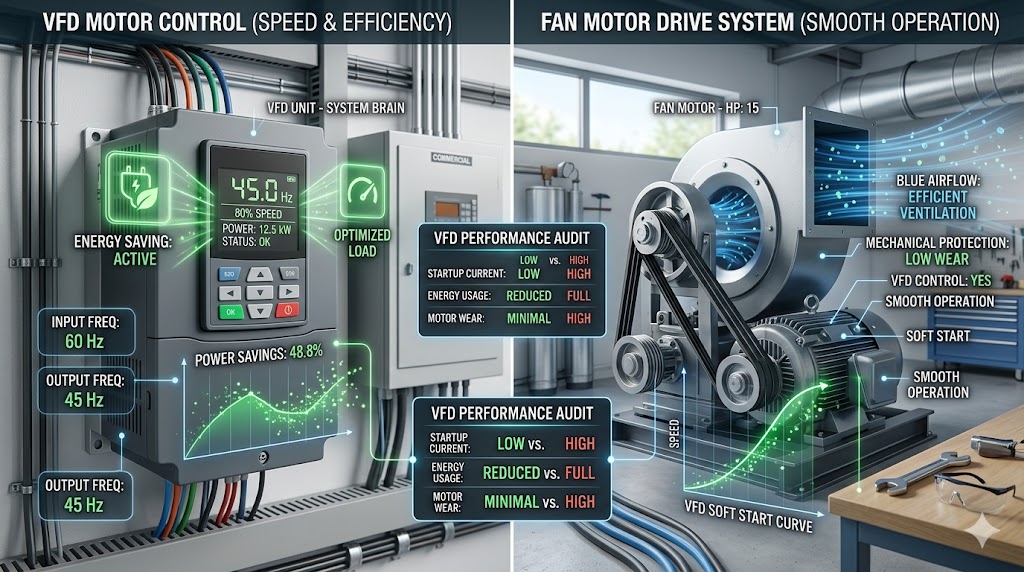
The primary value of a VFD is found in the Affinity Laws, which state that if you reduce a fan’s speed by just 20%, you reduce its power consumption by nearly 50%. Beyond massive energy savings, VFDs provide “soft start” capabilities. Instead of a violent surge of electricity hitting the motor at startup (which causes mechanical wear and high peak-demand charges), the VFD gradually ramps the motor up to speed. This reduces stress on belts, bearings, and motor windings, significantly extending the lifespan of your most expensive HVAC equipment.
To see how much a VFD could save on your facility’s utility bills, use the VFD Energy & ROI Auditor below.
What is VFD in an HVAC system

You may not even know what a VFD device is and why is it used, right? Here’s everything you need to know about it:
The term VFD stands for Variable Frequency Drive.
A variable frequency drive is an electrical device that is responsible for controlling the rotating speed of an (alternative current) electrical motor by controlling & adjusting the frequency of electrical power that is supplied to the motor.
Variable frequency drive is one of the best and most useful devices ever applied to HVAC systems. The primary job of a VFD device in HVAC systems is energy management.
There are a lot of benefits of a variable frequency drive. It helps you save more energy & also improves the overall performance of your HVAC system.
How VFD works in the HVAC system
Are you wondering how does a VFD device works in HVAC systems? We got everything explained in detail for you:
The working process of a variable frequency drive in HVAC systems is very interesting.
Variable frequency drive works exactly like the throttle of a car. You push it when you need acceleration & you stop pushing when you do not need acceleration anymore.
Variable frequency drive also works on a similar ‘based on demand’ principle.
It responds to the signals given by a controller and allows your equipment to only run at the electrical power that is needed to meet the cooling or heating temperatures you have set. Nothing less & nothing more.
How does it help?
Well, a VFD device adjusts the speed of a motor or fan of an HVAC system. It helps you save more energy and also increases the lifespan of your HVAC equipment.
This is why VFD systems are considered very important for an HVAC system.
Benefits of VFD in HVAC
We can guess what’s going on in your mind. Are you thinking that why is VFD so special? What are its benefits?
Here are all the benefits of a VFD device in HVAC systems:
Energy savings
Everyone wants to save as much energy as possible to reduce their utility bills and you surely want to do that as well.
A variable frequency drive only supplies the amount of electrical power to your HVAC system that is needed for matching the set temperature requirements.
It does not allow the HVAC equipment to consume excess energy and reduces its power consumption.
This way you get great relief in the form of energy savings.
Increase the life of HVAC equipment
When you buy HVAC equipment with your precious money, you want it to last longer and give the best performance.
If there is no variable frequency drive in your HVAC then the motors or fans have more risk of wear and tear and damage.
Because when the unit starts, the motors draw a huge amount of current. This increases the stress on the motor and also increases the chances of wear & tear and damage to the motor.
As a result, the life & performance of your HVAC equipment significantly decreases.
When you will use a VFD device for the HVAC system, the VFD only provides a small amount of current to the motor at the start and then keeps increasing it gradually.
This way there is no mechanical stress on the motor and that means less wear and tear and less damage. As a result, the life of your equipment will increase.
Power improvement
Variable frequency drives improve the power factor of all the motors of an HVAC system as well as the VFD device itself.
Metering
What’s more special about the variable frequency drive?
Well, it can also play the role of monitoring and metering the system performances.
Regulation of motor speed
Variable frequency drive also provides a step-less regulation of the speed of the motor.
Precise control
By using a variable frequency drive, you get a more precise performance & control of the HVAC equipment.
💡 Pro Diagnostic Tip: VFDs are the critical component that allows TFA (Treated Fresh Air) units to function efficiently. Because fresh air requirements change based on building occupancy, a VFD tells the TFA fan to slow down when fewer people are present, ensuring you don’t over-ventilate and waste energy.
VFD HVAC cost
You have seen the benefits of variable frequency drive and you must be thinking about how much it costs?
Well, if you want to apply a VFD device to your HVAC system, then it is going to cost you at least $200 to $500 per horsepower (HP).
However, the exact price may vary as it depends upon the cost of labor and different equipment in your local market.
HVAC VFD control
Are you thinking that what does a VFD device controls & how does it do that?
Variable frequency drive controls the speed of the motors or fans of an HVAC system. It does so by adjusting the frequency of the electric current that is supplied to those fans or motors.
We will make it easy for you to understand the control of a VFD device.
Think of it as the throttle of a car.
When you need speed, you push the throttle. When you don’t need speed you leave the throttle and don’t push it.
Similarly, a variable frequency drive only supplies that amount of electric power to the equipment that is needed to meet the set temperature requirements.
No less or more than that.
This way it reduces the energy consumption of the HVAC equipment and also increases its life.
VFD full form in HVAC
Are you wondering what is the full form of VFD in HVAC systems?
Well, VFD stands for Variable Frequency Drive.
Whereas, HVAC stands for Heating, Ventilation, and Air Conditioning systems.
Is VFD worth it for HVAC
Yes, a VFD device is very beneficial for HVAC systems.
It will provide you with many benefits like:
- Energy saving
- Less wear and tear of equipment
- Longer life of the equipment
- Better control of the equipment
💡 Pro Diagnostic Tip: Modern VFDs do more than just control speed; they are sophisticated diagnostic tools. If a VFD detects an over-current or a grounded motor, it will trigger an internal lockout to prevent a fire. If your fan has stopped, check the VFD display for an alarm. You can cross-reference these with our HVAC Error Code Index to find the specific fault.