When a natural disaster strikes and thick volcanic ash or dense wildfire smoke blankets your neighborhood, the air outside becomes incredibly dangerous to breathe. Because you are trapped indoors, usually in sweltering heat, a vital survival question arises: Can I use my air conditioner during ashfall? The answer is yes, but only if you have the correct type of system and it is set to the proper mode. There is a massive misconception that central air conditioners pull fresh air from the outside. They do not. Central ACs and mini-splits operate on a closed loop, meaning they only recirculate the air already inside your home. However, if you use a window unit, an evaporative cooler, or leave your system’s “Fresh Air Intake” open, you will literally pump highly abrasive, toxic silica dust directly into your living room.
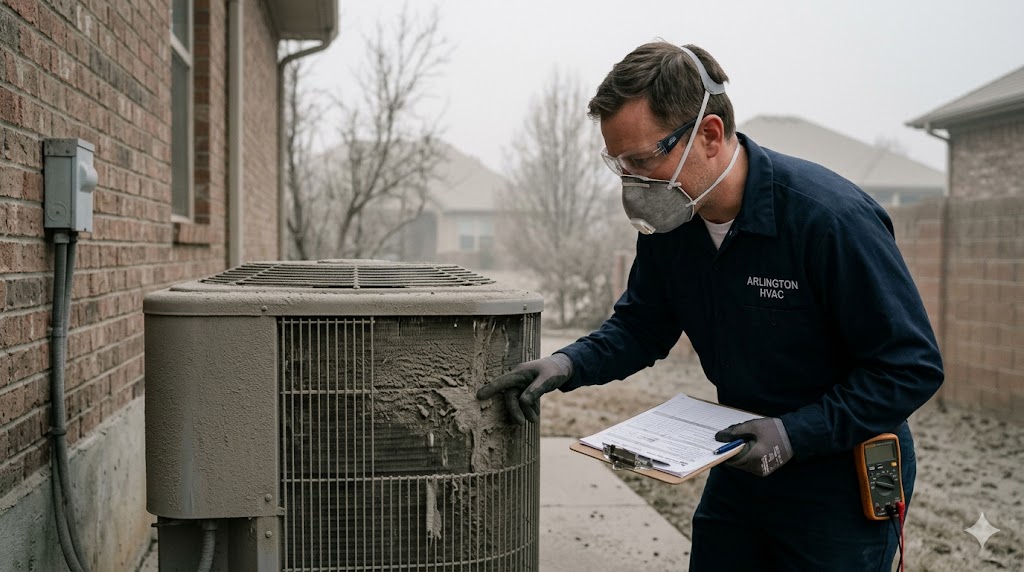
Furthermore, while you are safe indoors, that falling ash is settling like concrete dust over your outdoor condenser, threatening to suffocate the fan and permanently destroy the compressor motor.
Before you touch your thermostat, use our Interactive Ashfall Safety Assessor below. Select your specific AC type to instantly see if it is safe to run, what settings you must change immediately, and how to protect the outdoor equipment from catastrophic failure.
Identify your system to get immediate emergency operating instructions.
How Ashfall Affects Your Home’s AC System
To understand how to safely navigate a severe ashfall or wildfire smoke event, you must understand how your air conditioning actually works.
Central air conditioners and ductless mini-splits use a closed-loop refrigeration cycle. The outdoor unit (the condenser) does not blow outside air into your house. Instead, it pumps refrigerant gas back and forth through copper pipes. The indoor unit sucks in the air already inside your living room, cools it down by blowing it over the chilled copper pipes, and pushes that exact same air back into the room.
Because no outside air is introduced, running your central AC is actually the safest thing you can do for your lungs during an ashfall. The AC will continuously push your indoor air through your system’s air filter, scrubbing out any smoke particles that manage to leak through your window and door frames.
The Hidden Danger to Your Outdoor Compressor
While your lungs are safe indoors, your outdoor equipment is fighting for its life.
Volcanic ash is not soft like regular dust; it is made of pulverized rock and microscopic shards of glass. When the outdoor condenser fan spins, it acts like a giant vacuum, sucking that abrasive ash directly into the delicate aluminum fins of the unit.
Once those fins are clogged with ash, the system can no longer release heat. This extreme heat buildup causes the unit to work twice as hard, eventually tripping its internal thermal overload safety switch. If the ashfall has stopped but your system still won’t turn back on, use our diagnostic guide on what causes an AC compressor to stop working to see if the contactor, run capacitor, or the compressor motor itself was destroyed by the extreme mechanical strain.
Post-Ashfall Deep Cleaning and Indoor Air Quality
When the disaster has finally passed and the skies clear, your work is not quite done. Do not simply turn your AC back on and forget about it.
When abrasive volcanic ash mixes with the normal, everyday condensation inside your AC’s drain pan and evaporator coils, it forms a heavy, cement-like sludge. If left untreated, this sludge dries out and blocks the drain lines. Worse, it traps moisture and becomes a massive breeding ground for dangerous bacterial and fungal growth.
If you begin to notice a musty, dirty-sock odor blowing from your vents a few weeks after a smoke or ash event, check your system’s biological status using our AC Mold Risk Calculator. You will likely need to schedule a professional chemical wash immediately to clear the lines and sanitize your breathable air.
Maintenance Checklist During the Event:
- Upgrade Your Filter: Swap your standard fiberglass filter for a MERV 11 or MERV 13 rated filter to capture micro-particles of smoke and ash that seep into the house.
- Wash the Condenser (Carefully): Turn the power off at the breaker. Use a garden hose on a gentle mist setting to rinse the grey ash off the outdoor fins. Do this daily during the event so the ash does not solidify.
- Never Use a Pressure Washer: High pressure will embed the glass-like ash permanently into the metal and crush the fins flat.