In the field of electrical safety engineering, the Ground-Fault Circuit Interrupter (GFCI) is a precision device designed to detect differential current leakage between the ungrounded (hot) and grounded (neutral) conductors. While traditionally reserved for high-moisture residential areas, recent updates to the National Electrical Code (NEC 210.8) have expanded GFCI requirements to include outdoor HVAC condensers. This forensic guide analyzes the 5mA trip threshold and how modern inverter-driven AC units interact with high-sensitivity safety breakers to prevent catastrophic current-to-ground faults.
What is GFCI protection?
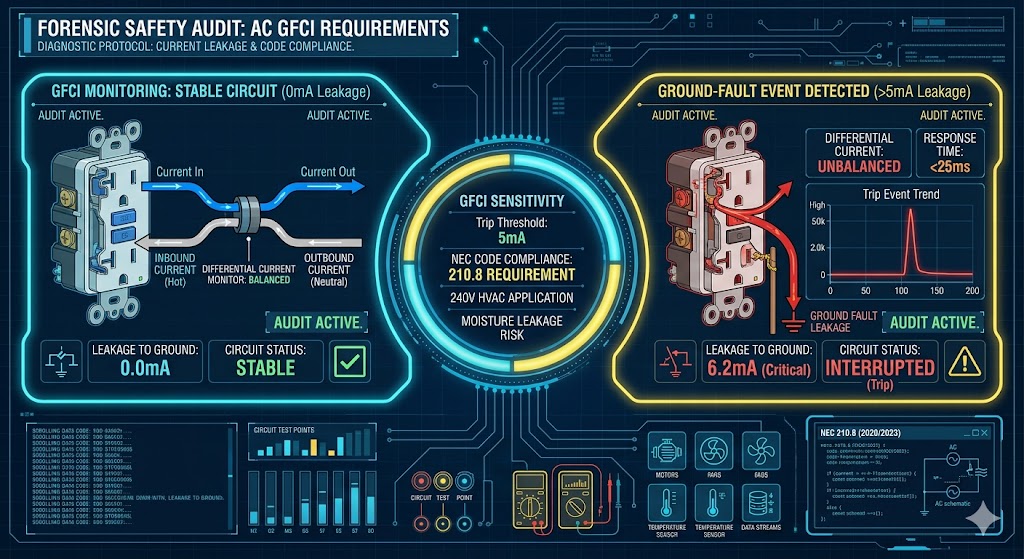
GFCI is an acronym for Ground-fault Circuit interrupter. It is also known as a Ground fault outlet. It is installed majorly to protect homeowners from direct exposure to shock while operating their electrical appliances. It is meant to shut off electrical connections when electrical current flows directly to the ground.
Does mini split require a GFCI breaker?
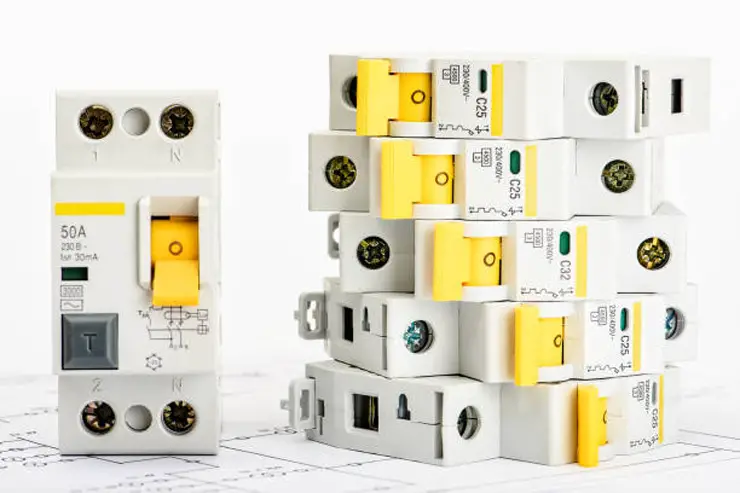
No, you don’t need a GFCI breaker for your mini-split Air conditioner. You do not need a GFCI breaker for your mini-split air conditioner unless it is connected to a receptacle with a cord and plug.
Do heat pumps require GFCI protection?
Yes and no. Confused? I am sure you are, well here’s the reason for my confused answer.
A heat pump is a circulation heater and falls under NEC 680.45 and would not require a GFCI unless it is supplied by a branch circuit that is below or exactly 150 volts. Therefore if your heat pump operates on 240 volts it will not require a GFCI.
How does a GFCI breaker work?
GFCI works by comparing the movement of current, to and fro, from an appliance to a circuit conductor and vice versa. Once the amount of current returning from the electrical appliance is different from the amount of current going into it by 5 milliamperes, the GFCI will automatically trip to interrupt the current.
For proper understanding, let’s consider this scenario. So, you just plugged your toaster into an outlet and you accidentally pushed the toaster into the sink with the tap running. Under normal circumstances, you should be electrocuted if you try to pick the toaster while submerged underwater and connected to the outlet.
However, if the outlet that your toaster is plugged into is a GFCI, the GFCI protection will automatically interrupt the power supply to your toaster, which means you can pick up your toaster without being electrocuted.
Is the GFCI breaker worth it?
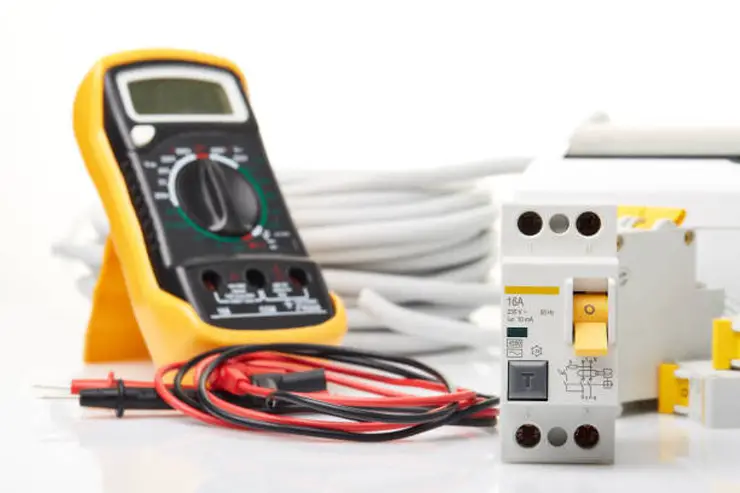
Yes, GFCI is worth investing in. Apart from the ultimate benefit of shock prevention that could be life-threatening, or can also help to prevent fire outbreaks and prevent your appliance from unnecessary damage, saving you have to spend unnecessarily on repairs or part replacement. These are some of the cogent reasons why GFCI is worth every single penny.
Why air conditioner GFCI plug tripping
When the GFCI of your air conditioner trips, the first thing that would come to your mind would be to think it is a result of a ground fault, however, sometimes, that is not always the case. Check below for other possible reasons why your GFCI may trip.
Spliced circuits
When you have more than one splice in the circuit of your GFCI, it is ok. However, the more splices you have in your GFCI, the higher the possibility that they are going to strain, and the more the GFCI is likely to break the circuit. If you have more than one splice in your circuit, change the wiring to a single length of wire to prevent your GFCI from tripping unnecessarily.
Original design
Tripping is something that is commonly seen in cords that has a built-in GFCI component in them. By design, these kinds of cords are meant to trip anytime they are unplugged from the socket. If your equipment trips anytime there’s a power outage, then that best explains your situation.
Circuit length
It is not advisable to use long circuits for GFCI because it just wouldn’t work well for them, this is so true of the GFCI version with standalone receptacles. To prevent your GFCI from tripping all the time, ensure that the GFCI receptacles installed in the circuit are not longer than 100ft. If it is, have it replaced.
Heavy circuit load
Is any other appliance installed together with your GFCI in the circuit? Well, you had better check now because that may be the reason why your GFCI is tripping. Oh, you just checked, is it the fluorescent light, the fan, or an electric motor? You had better disconnect them already because the energy they draw is so enormous that they can overwhelm your GFCI and cause them to trip.
Faulty equipment
Check for any faults in the appliance plugged into the outlet, have in mind that you are looking for something like, a loose wire or anything you see and feel is not right, this might cause your GFCI to trip. Although this is the case, your GFCI may not trip often, their interruption cannot be overlooked.
💡 Pro Diagnostic Tip: A “ghost trip” on a GFCI breaker is often caused by moisture on the outdoor disconnect terminals or carbon tracking in the compressor plug. If your GFCI trips immediately upon startup, use our AC Troubleshooting Protocol to perform a Megohmmeter test on the compressor windings before replacing the breaker.
How to know if a GFCI breaker is bad
Your GFCI is bad when your GFCI wouldn’t reset or anytime you press the “Test” button, it wouldn’t pop out. Or the reset button trips anytime you press it. Usually, this means there’s a current leakage within the circuit.
GFCI vs AFCI
Although both GFCI and AFCI are meant to prevent shock but are not to be confused with each other because they work differently. Check below for the differences between the two electrical installations.
- 1. Arc-Fault Circuit Interrupter ( AFGI) is designed to prevent fire that may occur as a result of arcing faults. Ground-fault circuit interrupter (GFGI) is designed to prevent electrical shocks.
- 2. AFCI is usually installed in places like the living room, family room, sunroom, recreation room, bedrooms, closets, e.t.c. GFCI is installed in entirely different places within the house. They are usually installed in bathrooms, garages, kitchens, laundry or wet bar sinks, crawl spaces e.t.c.
Do you need GFCI if you have AFCI?
No, you don’t need GFCI if you have AFCI. However, both can be combined to achieve what we call “feed-through”. Feed-through will protect all your electrical wiring and extension that is attached to the load side.
💡 Engineering Insight: While GFCI manages leakage to ground, the primary protection for your system’s amperage load is the standard thermal-magnetic breaker. To ensure your safety devices are paired with the correct wire gauge, see our guide on Air Conditioner Circuit Breaker Sizing for high-amperage HVAC circuits.