If you own an expensive gaming rig, a crypto mining setup, or a dedicated home server, you’ve likely wondered: Is air conditioning actually bad for my electronics? The short answer is no—air conditioning is actually the single best thing you can do for your hardware’s lifespan. Electronics generate massive amounts of heat; without an AC to remove that thermal energy, your CPU and GPU will “thermal throttle,” slowing down to protect themselves from permanent silicon damage.
However, there is one technical danger: Condensation. If your AC is set too cold and your room’s humidity is too high, water droplets can form on the cold metallic surfaces of your motherboards, leading to catastrophic short circuits.
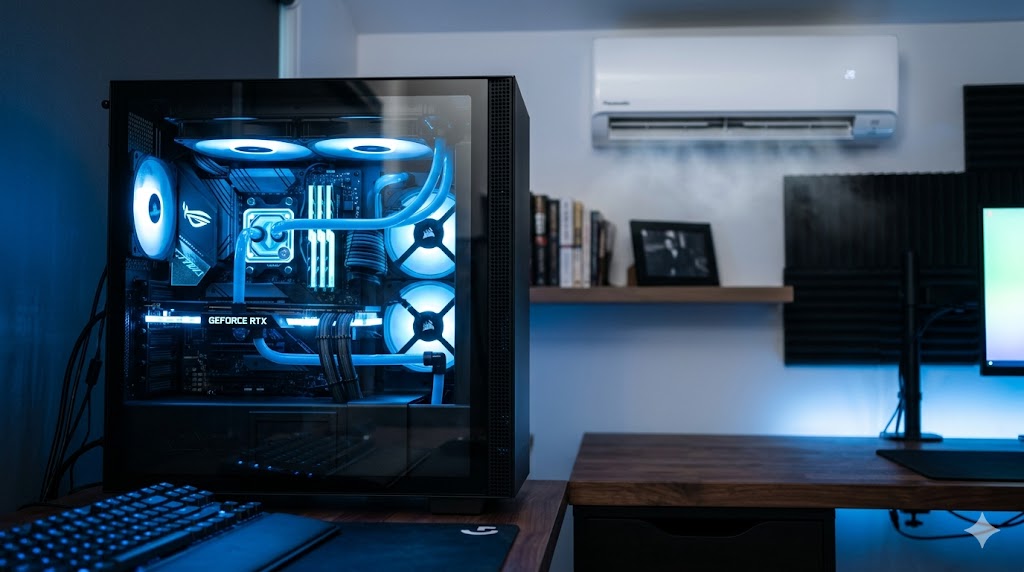
Before you turn off the cooling to “save” your computer, use our Interactive Electronics Safety Tool below. By calculating your room’s temperature against current humidity levels, the tool will tell you if you are in the “Safe Cooling Zone” or the “Condensation Danger Zone.”
Check if your AC settings are safe for your high-end hardware.
The Impact of Dust on Electronics and Air Quality
While the cool air from your AC is highly beneficial, a dirty AC unit is a nightmare for your hardware. If your air conditioner hasn’t been serviced recently, it will blow recycled dust, pet dander, and biological spores into your workspace. These particles eventually get sucked into your computer’s intake fans, coating the delicate heat sinks in an insulating layer of grime that causes them to overheat even in a cold room. If you notice a “musty” or dirty-sock smell in your office, your AC might be harboring dangerous fungal spores. Run a quick check with our AC Mold Risk Calculator to protect both your equipment and your health.
Power Surges: When the AC Itself Fails
It is important to remember that electronics aren’t just inside your computer; they act as the “brain” of your air conditioning system as well. Modern inverter units rely on complex printed circuit boards (PCBs) to regulate motor speeds and maintain efficiency. If your AC suddenly dies in the middle of a high-load task—leaving your servers or gaming rigs to overheat—it is often an electronic board failure within the unit itself. Before panicking, check our diagnostic guide on what causes an AC compressor to stop working to see if a simple blown capacitor or fried control board is to blame.
Will the air conditioner damage electronics
Although there are extremely low chances of getting your electronics damaged because of an air conditioner, you should keep this fact in mind that AC can damage them in a few cases. Where TV, computers, and laptops can survive for a long time, small electronics such as audio devices or extremely sensitive electronics are manufactured in a way that they cannot bear extreme temperatures, whether it is cool or warm. Maybe you will ask, do computers need air conditioning?
Make yourself clear that AC has nothing to do with the failure or success of your electronics but the level of humidity is the actual thing that is playing all the game. If you keep the humidity level perfectly fine for your electronics, you will never face any damages or issues even if you keep your air conditioner ON constantly for a whole week.
Can you put a TV in front of an air conditioner
You can put a TV in front of an air conditioner but it is not very recommended. There is moisture in the air whether your AC is taking it out of the room or getting it inside.
Experts claim that you should put your TV near the air conditioner unit instead of placing it in front of it. If your AC unit is installed on your wall at a relatively high place, you can put your TV just under the AC. There will be no harm in this practice.
Do keep this fact in mind that air conditioners can leak water due to any reason or malfunctions so there should be a shelf or protective sheets over your TV that can prevent water from entering the system.
In a nutshell, installing your TV on either side of your air conditioner unit is appropriate but you need to protect the TV and its wires from AC’s water leakage.
Can you put a laptop in front of the air conditioner
You can and should use your laptop in an air-conditioned room while sitting a little away from the AC unit. This will help you in keeping the laptop heat moderate and don’t let the temperature of your device go too high.
Putting your laptop just in front of an air conditioner can bring some harm to the device. We all know that the laptop’s temperature rises while running and the cool air of an AC can enter the device while forming the process of condensation.
The condensation process can build a layer of water inside your device which can lead to some short circuits or other issues. This factor can cause minor issues while sometimes can ruin your whole device as well. Although it is not very common, you should take precautions about the subject.
What humidity level is bad for electronics
If you visit a factory where electronics are being made or stored, you can see the boards saying that humidity should not exceed 50%. This is the ideal range of humidity in which electronics can work even more effectively without showing any signs of condensation.
Any level above 50 RH can cause some serious issues. There is no issue with the electrons or your air conditioner but the fact is that if there is too much moisture in the air, it will cause condensation on the heated components of your electronics.
This little condensation could be enough sometimes to cause short circuits which can eventually lead to component damage or complete failure of your electronic devices.
Safe humidity level for electronics

Humidity is the amount or percentage of water vapor immersed in the air. We need to protect our electronics from humidity just like we protect them from water. You will be pleased to hear that the humidity level preferred by human beings is ideal and best suitable for electronics as well.
This is the reason that there are minimum chances of getting your electronics damaged in an air-conditioned room. Humans can live properly in a room with a humidity level of 30% to 50%. The same goes for electronics as well but as said earlier, a humidity level above 50% can cause some issues in your electronics.
How to protect your electronics in an AC room
- One of the best and easiest ways is to keep your electronics a little away from your air conditioner unit. AC cannot harm devices even if they are sitting at a distance of a few feet.
- Set the humidity level properly, it should not be too high or low. Setting humidity in a proper manner can bring some real benefits in terms of electronics.
- A dehumidifier can protect your electronics in an efficient manner. Humidity is the major enemy of electronics and dehumidifiers can keep the humidity level at an appropriate place so that you can enjoy the cool air while increasing the life of electronics in the room as well.
- Install your air conditioner unit on a wall at a proper height. This will protect electronics as the air will not directly hit the electronics but will be dispersed in the whole room.
- AC can extract air from outside and while doing so, it can bring some dust particles as well. Such particles can get inside your electronics and build a layer of debris. Keeping the external place near the AC’s outdoor unit clean and clear can also bring efficient results.