In the HVAC industry, PTAC stands for Packaged Terminal Air Conditioner. These are self-contained, ductless units designed to provide cooling and heating to a single room through a wall sleeve. If you’ve ever stayed in a hotel and controlled the temperature via a unit under the window, you’ve used a PTAC. Unlike a central air system that uses a network of ducts, a PTAC houses all its components—compressor, condenser, and evaporator—within a single cabinet.
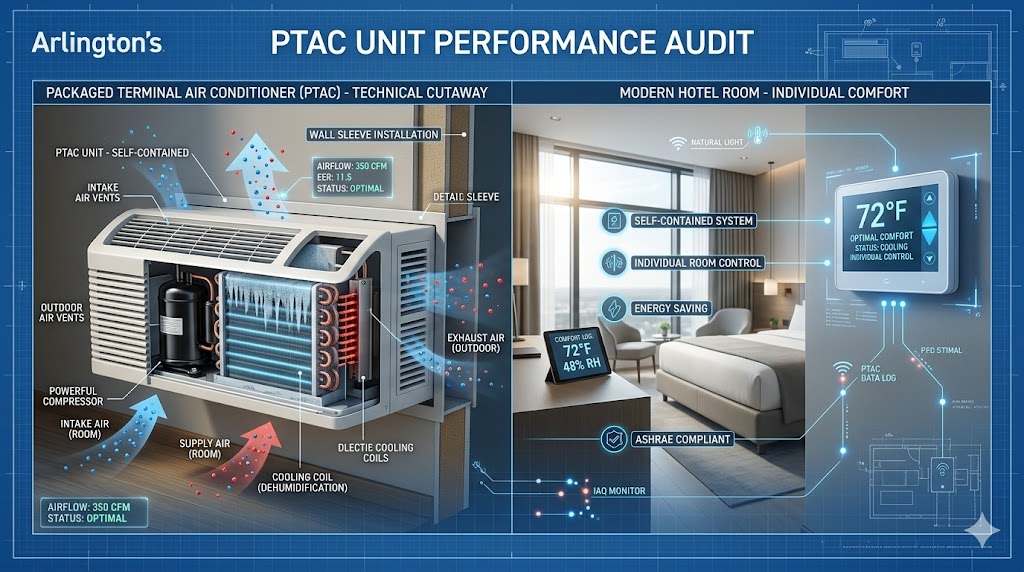
PTAC units are the gold standard for “individualized comfort.” They allow occupants in an apartment or hotel room to control their own environment without affecting neighbors. However, choosing the right PTAC isn’t just about brand; it’s about matching the BTU (British Thermal Units) to the room’s specific square footage and insulation. An undersized unit will run constantly and spike your bill, while an oversized unit will “short-cycle,” leaving the air feeling clammy and humid.
To find the perfect balance between comfort and energy cost, use the PTAC Sizing & Efficiency Auditor below.
What is a PTAC HVAC unit

The word PTAC stands for “Packaged Terminal Air Conditioner”.
PTAC is ductless and self-contained contained heating & cooling systems that are mostly used for commercial purposes.
PTAC HVAC units are called self-contained because they do not need any duct for working. They allow you to heat or cool only one room of the building without affecting the rest of the building.
PTAC units are so famous because they are very easy to install and also offer very impressive performance.
You will find PTAC HVAC systems installed in apartment buildings, hotels, schools, hospitals, etc.
The reason is that PTAC systems allow all the inhabitants of the building to choose a comfortable temperature in their room without affecting the temperature of the rest of the building.
Pros and cons of PTAC units
If you are thinking about buying a PTAC HVAC system, then you must take a look at these pros and cons of a PTAC unit:
Pros of PTAC unit
Here are the benefits of a PTAC unit:
1. Very effective performance
Earlier, people used to say that PTAC systems consume too much energy and don’t give much effective performance.
But since then, the manufacturers of PTAC systems have worked a lot on improving their performance.
The modern PTAC HVAC systems are known for giving extremely effective heating and cooling performance.
2. They can be used throughout the year
PTAC HVAC can be used all year long. You can use them for heating in winter and cooling in summer.
Therefore, you can use them for any purpose whenever you want.
3. Very easy installation
Installation is a big concern for everyone.
If you want an HVAC system that is very easy and economical to install, then PTAC HVAC systems are the best choice for you. You do not need any ductwork for installing and operating the PTAC HVAC systems.
This way you can save a lot of money on the installation of the HVAC system.
4. They are inexpensive
PTAC HVAC systems are available at an affordable price in the market. They are much cheaper as compared to the other HVAC systems available for commercial use. Moreover, it will be easy for you to replace the unit in case of any problem.
5. Multi-room comfort
One of the best uses of PTAC HVAC systems is that they offer you multi-room comfort.
PTAC systems work in one room only.
You can use them in hotels, hospitals, schools, universities, for multi-room comfort.
Everyone in the building can get the comfortable temperature they want in their room without affecting the temperature of the other rooms.
6. Requires less maintenance
If you are looking for an HVAC system that needs less maintenance then PTAC systems are the best choice for you.
It will help you save money.
Cons of PTAC unit
Here are the drawbacks of using PTAC:
1. Not ideal for home use
PTAC HVAC units do not suit well in the rooms. They just do not match the aesthetics of a room.
2. Noise problem
If you do not want a noisy HVAC unit then PTAC is not for you.
PTAC units are noisy as all of their components are inside the room. So, you need to think about this factor as well.
On the other hand, if you need a quiet solution then mini-splits might be a good option for you.
3. They are one-dimensional
PTAC units are one-dimensional and work in one room only.
You can use them for controlling the temperature of a single room and not the entire building.
This factor might be of great concern for some people.
Are PTAC units energy efficient
Yes, PTAC units are energy efficient.
They help you save a lot of money on energy bills by only cooling or heating the rooms you want.
This way they will save energy and cost you less money.
Moreover, PTAC units have less maintenance. They are affordable and easy to repair and replace. They are easy to install as well.
So, overall, the PTAC unit is very economical and money-saving.
💡 Pro Diagnostic Tip: PTAC energy efficiency is often measured by its EER (Energy Efficiency Ratio). To maximize this, ensure your unit is managing Enthalpy correctly. High indoor humidity makes a PTAC work harder, reducing its effective EER and increasing your utility costs.
Common problems with PTAC units
What are some common problems that people face with PTAC HVAC units?

We got all of them covered below:
- Ice forming.
- Mismatch of temperature.
- Leakage of water inside the apartment.
- The unit now blowing hot or cold air.
- Cracking or humming noises.
- Buttons not working.
- Circuit breaker tripping frequently.
- Air vents blowing black mold.
- Cold draft from both sides of the unit.
These are the most common problems that people often face with PTAC units.
How to repair the PTAC unit
If your PTAC unit is having some technical problems that you don’t know how to fix then the best option is to call a professional for repairing the PTAC unit.
They will identify the problem and then repair your unit accordingly so you can enjoy normal performance again.
PTAC vs window unit
PTAC units are a little bit more expensive than window units.
However, if you need both (heating & cooling) for a single room only and also save up to 20% on electricity bills then a PTAC unit can be the right option for you. Moreover, a PTAC can be installed in a wall and won’t occupy your window space.
💡 Pro Diagnostic Tip: While PTACs are great for individual rooms, they can be noisy because the compressor is inside the room. If your goal is a whisper-quiet environment, you may want to compare this to a VFD (Variable Frequency Drive) controlled mini-split, which can modulate motor speed for silent operation.
Where to buy PTAC units?
Are you looking to purchase a PTAC unit but don’t know where to buy one?
Here are some ways to do that:
1. Buy it online
These days you can easily buy anything while sitting at home with the help of the internet.
You can go to any of the top online market places like Amazon, e-bay, Ali-Baba, Samsung, Panasonic, Facebook groups, and other PTAC selling websites, etc.
There you can choose your favorite PTAC unit with the specs you want. Place your order, get the product delivered, make the payment, and enjoy it.
2. Buy from the local market
You can also go to your local market and explore a variety of PTAC units available there.
Then you can purchase your favorite one and bring it home.
PTAC unit installation
PTAC air conditioning units are very simple and easy to install as compared to the other HVAC units.
You can even install them in an existing hole. There is no need for ductwork for installing the PTAC unit.
That’s why PTAC units are also called self-contained air conditioning units.
How much does it cost to run a PTAC unit
It depends on how long you use the unit.
If you will use it for longer, it will cost you more.
If you will use it for a shorter time, it will cost you less.
But in general, PTAC units are cheaper and affordable. You can easily get one anywhere between $750 to $1000 depending upon the brand and quality.
Moreover, the installation can also cost up to $500 to $600.
The maintenance cost of PTAC units is also very low as compared to the other units.
What size PTAC unit do I need
Before you purchase a PTAC unit, you need to measure the size of your room. The size of your room in square feet will help you determine the size of PTAC you need.
The thumb rule is that the bigger the size of the room, the bigger number of BTU you will need.
The smaller the size of the room, the fewer the number of BTU you will need.
Here’s a list to help you with that:
| Room Size | BTU needed |
|---|---|
| 250-300 sq ft | 7500-9000 BTU |
| 300-350 sq ft | 9000-10500 BTU |
| 350-400 sq ft | 10500-12000 BTU |
| 400-450 sq ft | 12000-13500 BTU |
| 450-500 sq ft | 13500-15000 BTU |
This table will help you choose the right size of PTAC unit for your room.