If you have recently noticed a musty, “dirty sock” odor blowing from your vents, or if you are experiencing sudden allergy flare-ups indoors, you are likely asking a very common question: Can an air conditioner get moldy? The answer is an absolute yes. In fact, air conditioners provide the perfect breeding ground for mold. As your AC cools the warm air in your home, it extracts moisture. This moisture drips down into a condensate drain pan. When you combine this constant dark, damp environment with the dust and dead skin cells pulled in through your return vents, you create an all-you-can-eat buffet for fungal growth and black mold.
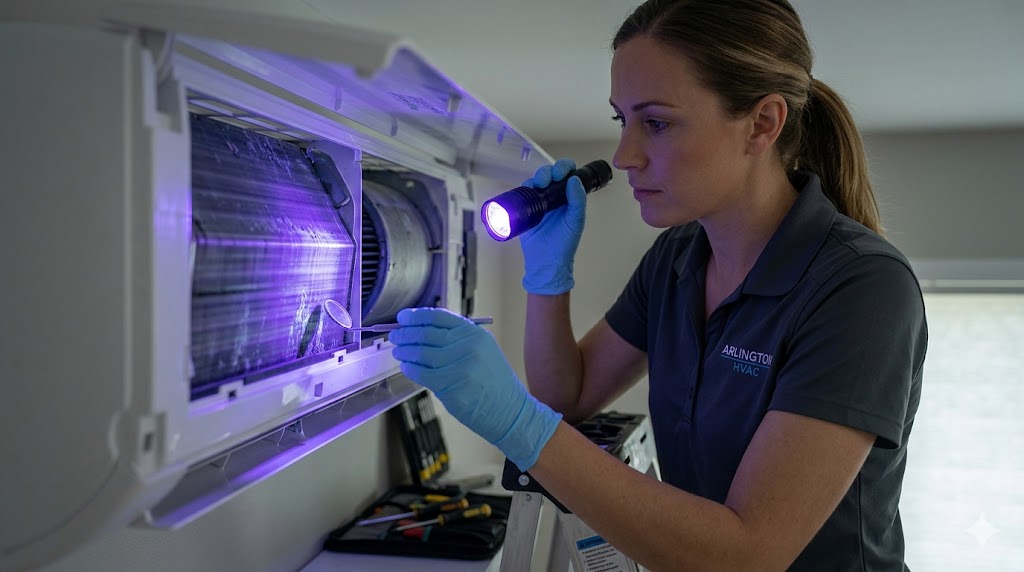
Before you panic or start spraying harsh chemicals into your ductwork, use our Interactive AC Mold Risk Calculator below. By answering four simple questions about your system’s usage and environment, you can instantly gauge your mold risk and determine if you need a simple DIY filter change or a professional chemical wash.
Evaluate your system’s current fungal and bacterial risk level.
⚠️ Pro Safety Tip: While swapping out a dirty fiberglass filter or pouring a cup of white vinegar down your condensate drain line are excellent DIY maintenance steps, you should never attempt to scrub mold off the delicate aluminum evaporator coils yourself. The fins bend easily, and disturbing active mold spores will instantly spread them throughout your entire home.
How Condensation Leads to Mold
When mold and bacterial slime build up in your AC, it eventually slides down into the condensate drain pan. This jelly-like sludge will clog the drain pipe, causing water to back up and trip the system’s safety sensors. If your unit has suddenly shut down, check your digital display—this exact issue triggers the Mitsubishi P4 Error Code and the Samsung Blue & Yellow flashing light sequence.
Health Risks & System Failures
Mold doesn’t just damage your lungs; it destroys your AC’s efficiency. When the evaporator coils are choked with fungal growth, the unit must work twice as hard to cool your home. This immense strain is a leading reason why AC compressors suddenly stop working, turning a $150 cleaning job into a $2,000 replacement.
Can mold grow inside air conditioners?
Yes, mold can grow inside air conditioners.
Mold requires darkness, moisture, warmth, and still air to grow. An air conditioner has all these things. That’s why an air conditioner is the best breeding ground for mold spores.
Mold can grow in the drain pans, air filters, air ducts, and evaporator coils of your air conditioner. Once mold grows inside your AC, it will spread everywhere in your house and contaminate the air. Can you run an air conditioner without a filter?
Why does an air conditioner get moldy?
It’s because an air conditioner provides a suitable environment for the mold to grow and spread.
Mold needs darkness, moisture, warmth, dust, still air, and water to grow.
Now if you look at your air conditioner, it is dark inside, it has moisture, dust, still air, and water. Such conditions are favorable for mold and promote its growth.
How do you know if your air conditioner has mold?
If you are not sure whether there’s mold inside your air conditioner or not, you need to look for a few symptoms.
Symptoms of mold in air conditioner
If you observe any of the following symptoms, it means there is mold in your air conditioner:
1. Visible signs of mold
If you can visibly spot patches of mold on different parts of your air conditioner, it is a clear symptom of mold infestation inside your AC.
2. Strong musty smell
If there’s an unusual musty smell lingering in your house all the time & it increases when the air conditioner is running, it means there is mold inside your air conditioner.
Especially, if the smell is strong close to the location of the air conditioner, it is a clear symptom for you.
3. Mold-related illness
If you or your family members have developed mold-related illnesses like irritated throat, eyes, nose, and allergic reactions for no apparent reason, then it is a sign that there might be mold inside your air conditioner.
Inhaling moldy air coming from the air conditioner causes such health problems.
4. Hire professionals for inspection
You can also hire professionals for thorough inspections of your air conditioner.
They will use modern tools and technology to check if there is any mold inside your AC unit.
What does mold in AC smell like?
Mold in the air conditioner gives out strong mildew or musty odor.
The moldy air blown by the air conditioner smells like wet socks, rotten wood, meat, or earth.
This can help you identify if there is mold inside your AC or not.
Is mold in the air conditioner dangerous?
Yes, mold in an air conditioner is dangerous for your health. If there is mold inside your air conditioner, it will be blown into the air by your AC. This way the mold spores will spread in the air all across your home. Now when you and your family will inhale this contaminated air, they will develop serious health problems.
That’s why mold in the air conditioner is dangerous for everyone.
Can you get sick from a moldy air conditioner?
Yes, you can get sick from a moldy air conditioner. The reason is that a moldy air conditioner will blow the mold spores in the air of your room.
It is not healthy to inhale contaminated air containing mold spores. It will make you sick and cause health problems.
Health risks of mold in air conditioners
Inhaling moldy air can lead to health problems like irritated noses, throat, eyes, extreme allergic reactions, asthma, coughing, sneezing, bronchitis, pneumonia, and breathing problems.
If you are allergic to molds, you are vulnerable to even serious health risks due to inhaling moldy air.
What kind of mold grows in air conditioners?
Generally, there are thousands of different types of molds. However, 3 main types are commonly found in the air conditioners:
Is the black stuff in my AC mold?
Yes, if you have spotted black dusty patches on different parts of your air conditioner, it might be mold.
Can window air conditioners get moldy?
Yes, window air conditioners can get moldy. However, window air conditioners are easy to inspect. So, you can easily remove the mold from them.
Can car air conditioners get moldy?
Yes, mold can grow in your car’s air conditioner due to moisture, dust, and darkness.
It is not so easy to remove mold from car air conditioners.
Can wall-mounted air conditioners get moldy?
Yes, wall-mounted air conditioners can also be affected by molds.
Can central air conditioners get moldy?
Yes, central air conditioners are vulnerable to molds.
If there are molds inside your central air conditioning system, it will be quite challenging to remove them. The reason is that central AC units are so big and mold can be located at an inaccessible location.
The AC unit will also blow the mold all over your house. It is better to hire a professional for removing molds in this type of AC unit.
Can free-standing air conditioners get moldy?
Yes, molds can affect your free-standing air conditioners. But it is easy to inspect and remove mold from such AC units.
How to keep the air conditioner from getting moldy?
Here is what you can do to keep molds away from your air conditioner:
Solution 1 – Keep the drain pans clean
Always keep the drain pans of your air conditioner clean.
Otherwise, the standing water present in them would lead to the growth of mold.
Solution 2 – Clean the air filters
The air filters of your AC should always be clean.
If the air filters are always clogged with dust, it will promote the growth of mold.
Solution 3 – Control the humidity
Excess humidity promotes the growth of mold. You need to control the humidity levels to prevent the growth of mold.
You can do so with the help of a dehumidifier or use the humidity controls of your AC.
Solution 4 – Don’t the leave the AC idle
If you are leaving the house for a long time, you should not turn the AC off.
It will stop the airflow and provide a favorable environment for mold growth.
You should keep the AC running on auto mode so there’s smooth airflow and no growth of mold.
Solution 5 – Clean the AC unit properly
Never leave your AC unit dirty because it will promote the growth of mold.
Instead, you should clean it regularly every week. This will keep the molds away. WD40 aircon cleaner may help.
How to clean mold from air conditioners?
If you have spotted the mold inside your AC and want to remove it yourself, here’s what to do:
Step 1 – Get ready
Turn off the air conditioner. Wear a face mask, gloves, and goggles & get ready for removing the mold.
This will protect you from exposure to mold and save you from health problems.
Step 2 – Remove & clean the filter
Now remove the air filters of your AC.
If they are disposable, then replace them with new and clean ones.
If they are not disposable, clean them with warm soapy water and dry them.
Reinstall the filter when completely dry.
Step 3 – Clean the moldy areas
Use a clean cloth dipped in warm soapy water to wipe all the moldy areas on your air conditioner.
Make sure to thoroughly clean everything.
Step 4 – Hire professionals
If you cannot find the mold inside your AC or you have no experience with opening different parts of an air conditioner and cleaning them, you should hire a professional.
Don’t try it yourself because you will end up damaging the air conditioner which will cost you even more money. Just call a professional. They will use the latest tools and technology to find the mold inside your AC and remove it successfully.
Curious to know can a humidifier cause mold?