A Schrader valve is the primary access point for your HVAC system’s refrigerant circuit. Often referred to as a “service port,” this small, spring-loaded poppet valve is what allows technicians to connect gauges, measure pressures, and add or remove refrigerant without letting the entire system charge escape. While it is identical in design to the valves found on car tires or bicycles, an HVAC Schrader valve is built with specialized gaskets (usually Neoprene or Viton) designed to withstand high-pressure chemical refrigerants and compressor oils.
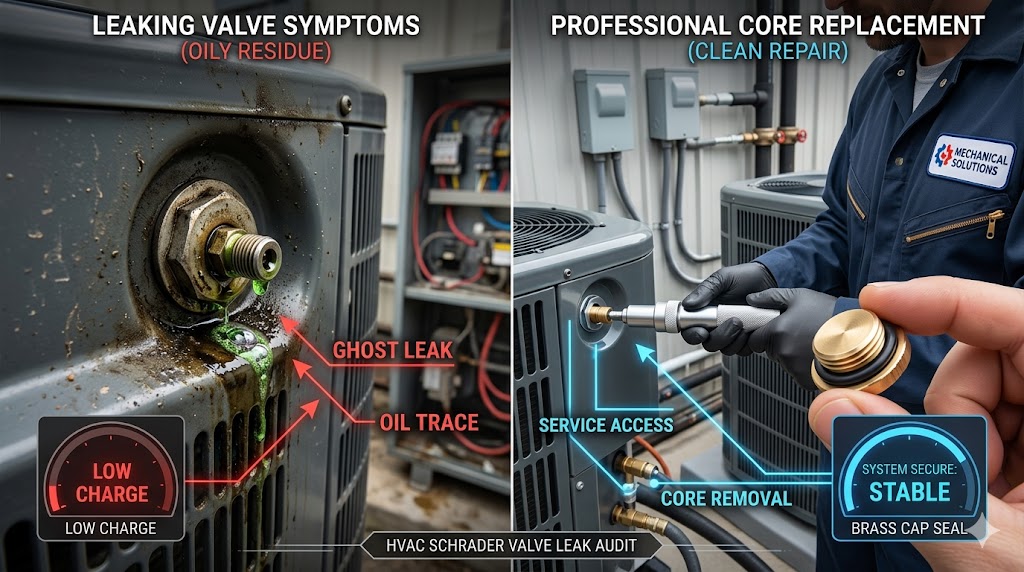
Despite their small size, Schrader valves are a common failure point. Over time, the internal rubber seal can harden, or the spring can lose tension, leading to a slow, “ghost” refrigerant leak. Because these ports are located on the high and low-pressure lines of your outdoor unit, a minor leak here can lead to a total system freeze-up or compressor burnout if left unchecked. Understanding how to audit these ports for leaks—and why the brass service cap is actually your primary seal—is essential for long-term system reliability.
To see if your service ports are compromising your system’s efficiency, use the Schrader Valve Leak & Integrity Auditor below.
What is a Schrader valve air conditioning

Schrader valve, service valve, and core valve are the different names of the same port that is considered when you or a technician is servicing an HVAC or air conditioner unit. This is the tool that allows the technicians to do the servicing of the unit effectively while helping him to diagnose issues efficiently.
Diagnosing the system with the help of a Schrader valve will make troubleshooting easy as you can directly reach the point that is making the system less efficient.
💡 Pro Diagnostic Tip: If a technician uses the Schrader valve and finds your pressures are extremely low, the system may have already entered a “Low Pressure Lockout.” If your indoor thermostat is flashing or your outdoor unit won’t start, use our HVAC Error Code Index to confirm if a pressure-related safety trip has occurred.
What does a Schrader valve do in an HVAC system
The Schrader valve has two major components that are equipped in a single packaged tool. One is the outer cover also known as a threaded hollow shell while the main component is its poppet valve that sits inside the hollow shell.
The mechanism and designs of the Schrader valve are composed in such a way that technicians can easily add or remove the refrigerant or any other gas inside the valve without worrying about any leakages. It helps in a high-pressure environment.
They are just like the valves commonly used in the tires of cars. The core of the valve threads down inside the springs. This process allows the refrigerant or gas to flow inside or outside of the valve whenever its core is pressed.
💡 Pro Diagnostic Tip: The Schrader valve is where technicians connect their digital manifolds to measure VSAT (Vapor Saturation Temperature). Without a properly functioning valve, it is impossible to determine if the refrigerant is boiling at the correct temperature to absorb heat from your home.
Are AC schrader valves universal
While considering the exterior end, almost all the air conditioner Schrader valves have the same size as they need to be compatible with all kinds of HVAC systems.
This factor makes it universal to get fixed at various places. You may be amazed to hear that their Schrader valves are widely used in airbags, tires, car ACs, and many other applications where airtight properties are required.
Do keep this fact in mind that there is a set standard size of Schrader valve for the whole world. There may be some difference in the size of the rubber as it may be thick but the thread and body of the valve will never vary.
Is the AC Schrader valve the same as the tire
Schrader is a well-known kind of pneumatic tire valve and it is the one that is widely used in different vehicles’ tires. You will be amazed to know that all the cycles and motorcycles in this world have Schrader valves in their tubes or tires.
They are the same as they have the same function whether they are installed in an air conditioner or a tire. They only have to control the air and never let it pass through it.
While adding air into the tire, the pin is pressed that pushes the rubber down and makes room for the air to go inside the motorcycle tire. Once the pin is unpressed, the rubber in the valve along with springs keeps the air at its place by not giving space to flow.
How much does it cost to replace a Schrader valve in HVAC
Schrader Valve itself can be found in the market with a price ranging from $5 to $15. The cost to replace Schrader may vary depending on the technician but on average, a total replacement can cost you somewhere from $25 to $30. If you do it as a DIY project, you will only spend on buying the valve saving at least half of the total expenses.
How to replace the Schrader valve on AC?
- Before moving towards the Schrader valve replacement, it is highly recommended to ensure that there is no refrigerant in the line.
- If there is some refrigerant, discharge it by following the EPA rules and regulations.
- Locate the Schrader valve on AC or look for the user manual to find its exact location.
- Use special pliers to open the exterior body head by unscrewing it.
- Take out the Schrader valve by using tweezers or related equipment, carefully.
- Now place the new Schrader valve inside the body using the same tweezers (make sure that the direction of the valve is right).
- Put back the screw and tighten it properly. It should neither be overtightened nor be loosened.
- Fill the refrigerant and go on with the system as you normally do.
HVAC Schrader valve removal tool
There is a specific tool commonly known as the Schrader valve or valve removal tool. It comes in different shapes.
Some come in a bent L-like shape and you simply insert the small side inside the valve and move the long side.
The most common type of this tool comes in as a straight rod which has rubbers or metal in the middle for gripping purposes.
How to tighten a Schrader valve
- It can only be done using the specific Schrader valve opening tool.
- The Schrader valve has been screwed down in a small hole.
- Put the short end of the tool inside that hole.
- Move the long bent end of the tool with your hands in a clockwise direction until it looks tight.
- Hold the valve with one hand and give the last turn to the tool so that the Schrader valve can be tightened perfectly.
- Make sure you don’t try to over-tighten the valve as it may cause issues while opening again or may get damaged as well.