In modern, “airtight” homes, HRV stands for Heat Recovery Ventilation. As we build homes with better insulation and tighter seals to save energy, we accidentally trap stale air, odors, and moisture inside. An HRV is a dedicated ventilation system that solves this by constantly swapping indoor air for fresh outdoor air. Its brilliance lies in the “recovery” process: it uses a heat exchanger core to “steal” the temperature from the outgoing air and transfer it to the incoming air. This means in the winter, you get fresh air that is already pre-warmed, so your furnace doesn’t have to work overtime.
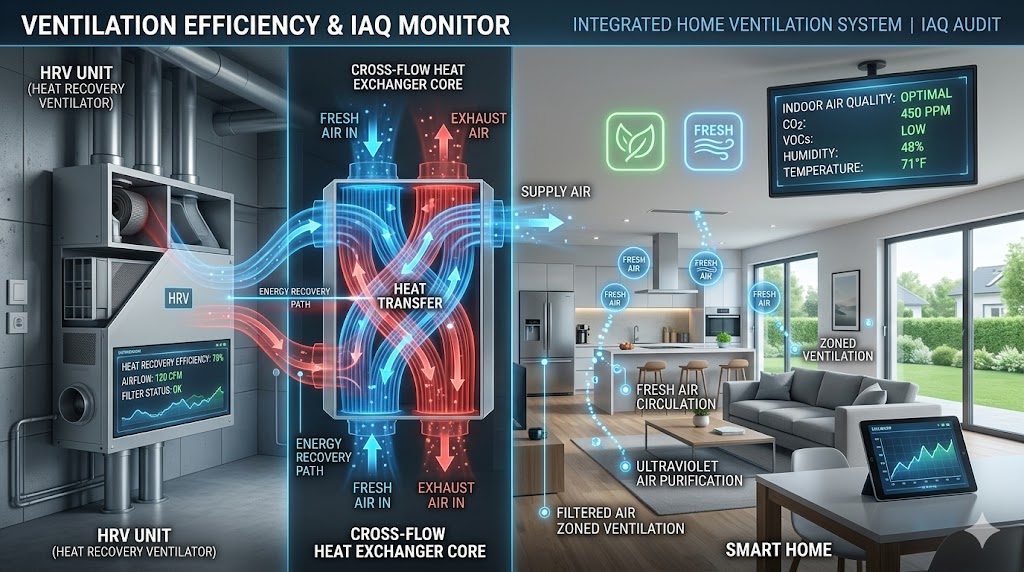
Unlike a standard exhaust fan, an HRV doesn’t just throw away the air you’ve already paid to heat or cool. It recovers up to 70-80% of that energy. However, there is a catch: a standard HRV only transfers sensible heat (temperature). If you live in a climate with extreme humidity, you might actually need an ERV (Energy Recovery Ventilator), which also manages moisture levels. Choosing the wrong one can lead to a home that is either too dry in the winter or like a sauna in the summer.
To see which system fits your specific climate and home build, use the Fresh Air & Ventilation Auditor below.
Is HRV air conditioning
Does an HRV system perform the role of an air conditioner?
The answer is yes. HRV systems also perform air conditioning. They are very effective for conditioning the air and keeping it clean.
HRV systems can also perform cooling & heating of the air in summer & winter respectively. They do so by preheating and precooling the air coming inside your home.
The best thing about the HRV systems is that they are energy-efficient. It means that they provide excellent air conditioning by using less energy. This way they reduce your energy bills as well.
HRV systems can be used in all climates and will make the air in your home, clean and comfortable.
Does HRV help the air conditioning system
Yes, an HRV system helps with air conditioning.
To understand how it all happens, we need to have a basic understanding of the working of HRV systems.
HRV means heat recovery ventilator systems.
HRV systems have mainly two air ducts. One is responsible for taking out the stale indoor air while the second one is responsible for bringing in the fresh outdoor air into your home.
HRV systems have a device called a heat exchanger. This device is responsible for transferring the heat from one airstream to another.
When the fresh air is coming in, the heat exchanging device extracts all the from it and transfers it into the stale indoor air that is going outside.
This way the incoming air gets precooled and you get excellent air conditioning within no time. That’s how HRV systems help with air conditioning.
What is an HRV air exchanger

Heat recovery ventilators have a very effective air exchanger system.
They exchange the stale indoor air with fresh outdoor air.
HRV has two air ducts. One takes the stale air outside while the other brings fresh air inside.
There is a heat exchanger device where both (incoming & outgoing) air streams pass through.
When you want cool air, then the exchanger device extracts heat from incoming air and transfers it into outgoing air. Thus, the incoming air gets precooled and you receive cold air.
When you want hot air, then the exchanger device extracts heat from the outgoing air and transfers it into the incoming air. Thus, the incoming air gets preheated and you receive warm air.
This is how the air exchange works in all the HRV systems.
Is HRV reliable
Yes, the HRV (heat recovery ventilator system) is very reliable.
They not only provide you with excellent air conditioning but also some amazing benefits.
Is an HRV system worth it
Yes, an HRV system is worth it.
Here are the benefits that an HRV system will provide you:
Healthy & clean atmosphere
HRV systems ensure that your home always has fresh air circulation. It prevents the growth of allergens, molds, and spores and saves you from many health problems.
This way your home gets a healthy & clean atmosphere (especially for children & people sensitive to allergy).
Comfortable environment
HRV systems also feature some filters that clean the air coming into your home. They remove all the dust, pollen grains, and other harmful particles from the air.
You will enjoy a clean, healthy, and comfortable environment in your home.
Useful in all climates
The best thing about HRV systems is that they can be used in all climates. You can use them to get cooling in summer &then you can use them for heating in winter as well.
That’s why HRV systems are reliable and worth it in every season & every climate.
Cost-effective
If your HRV system is functioning properly and has higher efficiency then it will help you save more energy and reduce your energy bill.
Remove carbon monoxide
Different appliances in our homes such as gas stoves release carbon monoxide into the air.
Constant exposure to carbon monoxide can cause headaches, irritation, high blood pressure, and other health problems.
HRV systems ensure proper ventilation and flow of fresh air into your home. This way it reduces the levels of carbon monoxide in your home & provides you with a clean and healthy environment.
How does the HRV ventilation system work
The working of the HRV system is very simple and easy to understand.
It takes out the warm stale air from your house and brings cool fresh air from outside into your home.
This process occurs with the help of 2 air ducts and 1 heat exchanging device.
How does the HRV cooling system work
HRV system has a heat exchanging device through which the incoming & outgoing air passes.
That device can extract heat from one airstream & transfer it into another.
When you need cold air, then the exchanging device extracts heat from the incoming air & transfers it into the outgoing air. This way the incoming air gets precooled and you get cold air.
How does the HRV heating system work
HRV heating system works exactly like the cooling system.
The exchanging device extracts heat from the outgoing stale air and transfers it into the incoming air.
This way the incoming air gets preheated and you receive warm air.
That’s how the HRV heating system works.
Does HRV purify the air
Yes, HRV purifies the air.
HRV systems have the latest nanofiber filtration technology that helps remove all the dust particles, molds, spores, pollen, and other harmful particles from the air before it gets into your home.
This way HRV provides you with a healthy, neat & clean environment to live in.
Is HRV connected to a furnace
The answer is yes.
HRV systems can also be connected to the furnace.
💡 Pro Diagnostic Tip: In commercial buildings, HRV technology is often integrated into a larger TFA (Treated Fresh Air) unit. These units use a recovery wheel to pre-condition 100% outdoor air before it ever reaches the main AC system, saving massive amounts of energy on cooling loads.
Difference between HRV and HVAC
HRV is one of the types of HVAC equipment.
HRV stands for heat recovery ventilation.
HVAC stands for heating ventilation and cooling.
The main competent of HRV is ERV which stands for energy recovery ventilation.
The key difference between both of them is that ERV transfers heat & moisture whereas HRV transfers heat only.
💡 Pro Diagnostic Tip: The main difference between an HRV and an ERV is how they handle Enthalpy. While an HRV only recovers ‘sensible’ heat (temperature), an ERV recovers ‘latent’ heat (moisture). Understanding the total heat content of your air is the key to choosing the right ventilation for your climate.