In the world of climate control, Reheat is the process of adding heat to air that has already been cooled by an evaporator coil. At first, this sounds like a waste of energy—why cool air just to warm it back up? The answer lies in the psychrometrics of air. To remove humidity, an AC unit must cool air below its “dew point” so moisture can condense into water. Often, by the time the air is dry enough to be comfortable, it is too cold (around 55°F) to be blown directly onto people. Reheat “tempers” this bone-dry air back to a comfortable 70°F before it enters the room.
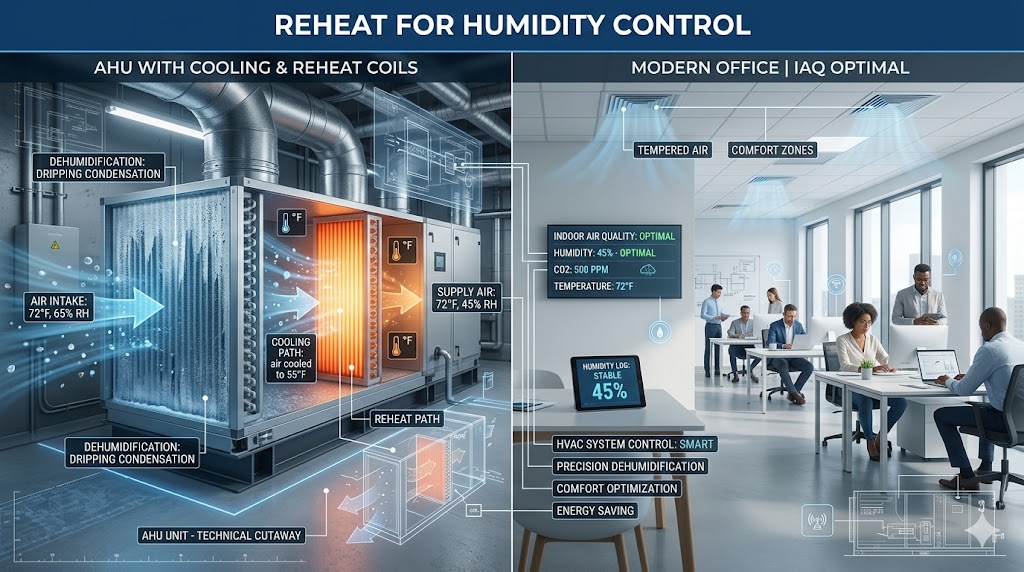
Without reheat, a system might reach the desired temperature and shut off while the air is still sticky and humid. This leads to the “clammy” feeling common in oversized AC systems. Reheat allows the compressor to keep running to pull out moisture without turning your room into a refrigerator. While it does consume more energy, it is the gold standard for maintaining a precise 50% relative humidity level in hospitals, labs, and humid coastal homes.
To see if your building’s humidity issues require a mechanical reheat solution, use the Reheat & Humidity Necessity Auditor below.
What is a reheat system

As the name suggests, a reheat system is the one that heats the previously cooled air.
Such systems add heat to the air that was previously cooled by the HVAC systems.
Now you must be thinking that why the reheat systems heat the previously cooled air? Well, there are mainly three reasons behind that:
- For controlling the humidity of the air inside your room.
- For the comfort of people inside the room (like when they need heating).
- To prevent excessive cooling of the space. When the system feels like the air is getting too cold, then it starts reheating to control its temperature and keep it at a comfortable level.
So, that’s what the reheat systems are all about. Let’s dig out more about them.
What are reheat coils
When we are talking about reheat systems, then the reheat coils always come into the discussion.
Well,
Reheat coils are one of the main components of a reheat system. They help the reheat systems to add heat into the air.
In HVAC systems, a reheat coil is the one that heats the air in the supply duct of the system and hence controls its temperature. In even easier words, the reheat coils heat the air before it leaves your HVAC system.
Without reheating coils, a reheating system will malfunction and won’t function properly.
Where are the re-heat coils located?
You must be thinking that where are the reheat coils located in your HVAC system?
Well, the reheat coils are located above the blower in most of the systems.
There it adds heat into the air before it is blown into your room by the HVAC system.
💡 Pro Diagnostic Tip: To maintain precise control over a reheat coil, engineers often use a VFD (Variable Frequency Drive) on the supply fan. This allows the system to slow down the airflow across the cooling coil for maximum dehumidification before the reheat coil tempers the air.
How does reheat work
Are you wondering how does the reheating system work?
Well, the job of a reheat system is to add heat to the already cooled air.
It does so for a few purposes like, controlling the humidity of the air and controlling the temperature of the air.
We will explain it to you in complete detail so you can easily understand the whole concept of working of reheat system.
Cooling and dehumidification with reheat
These days, a lot of bakeries and grocery stores use air conditioning units and reheat coils for dehumidification purposes.
How does it work?
Well, the air conditioners cool the air and remove all the moisture from it. But instead of throwing away that moisture and heat, the reheat coils put that heat back into the main airstream.
This way the reheat coils reheat the already cooled air and this whole system start working like a dehumidification system.
Is cooling and dehumidification with reheat cost-effective or not?
Now, this is the real question. Does cooling and dehumidifying with reheat help you save energy and money?
The answer is no. It is not much economical and cost-effective method.
You must be wondering why so here’s the thing explained in just 2 points:
Reason #1 – When the air conditioner is running in the reheat mode, then it is not doing any kind of cooling. No cooling from the AC means that the temperature of your space will also start increasing.
Reason #2 – To counter the increase in temperature, you will need more air conditioner units. This means you will have to spend more money and your energy bill might also increase due to an increased number of working air conditioner units.
You are forcing the air conditioner to do a job that it is not supposed to do and that’s why it is not a great idea practically.
Reheat coils for humidity control
Are you thinking about how does the reheat coils control the humidity of the air?
We will make it easier for you to understand it now.
The reheat coils of the HVAC system heat the air before it leaves the system. This prevents over-cooling of your room due to the low temperature of the dehumidified air.
As a result, the humidity of the air also fluctuates and this is how the reheat coils heat the system.
The frequent turning on & off of the compressor also plays a major role in the rise and drop of the humidity levels.
💡 Pro Diagnostic Tip: Reheat is fundamentally about managing Enthalpy. By cooling air to remove moisture, you lower its total heat content. Reheating then adds ‘sensible’ heat back in to make the air comfortable for occupants without re-adding the moisture you just removed.
Difference between reheat and preheat

Reheat and preheat are two terms that often confuse people and they are unable to differentiate between them.
We will make it easier for you to understand the basic difference between preheating and reheating.
What is reheat?
As the name itself shows, reheat means heating something that has cooled off.
In HVAC systems, reheating means adding heat to the already cooled air. It is done for controlling the temperature and controlling the humidity of the air for the comfort of the occupants of the room.
Reheating is done with the help of reheat coils that add heat into the air before it leaves your air conditioner unit.
What is preheat?
In HVAC systems, preheating means heating the air for bringing its temperature from below the freezing point to somewhere above the freezing point.
How is preheating done in the air conditioning systems?
Well, just like reheating systems, the preheating is also done with the help of some coils (they are called preheating coils).
Do HVAC really need a reheat system
Yes, HVAC systems do need reheat systems.
Reheat coils are used for controlling the humidity levels in the air. When your air conditioner is close to reaching the set temperature then the reheating system starts working.
It starts warming the air going into your room so that the compressor of the AC keeps running and continuously remove humidity from the air instead of just reaching the set temperature and shutting off.
It also prevents your room from getting over-cooled.
This is why preheat systems are important.